

24 Hours (of Style) in the Life of a Woman
Or, an elegant day out in Paris...

Editor’s note: Today’s article is by Aliénor Mathé, a jewellery designer in Paris. It has been translated and adapted from French.
As the majority of our Friday articles are for the fellas, this week we wanted to offer something special for the ladies. If you would like to read more from Aliénor in the future, let us know in the comments.
Regular programming to resume in August (we’re off next week!).
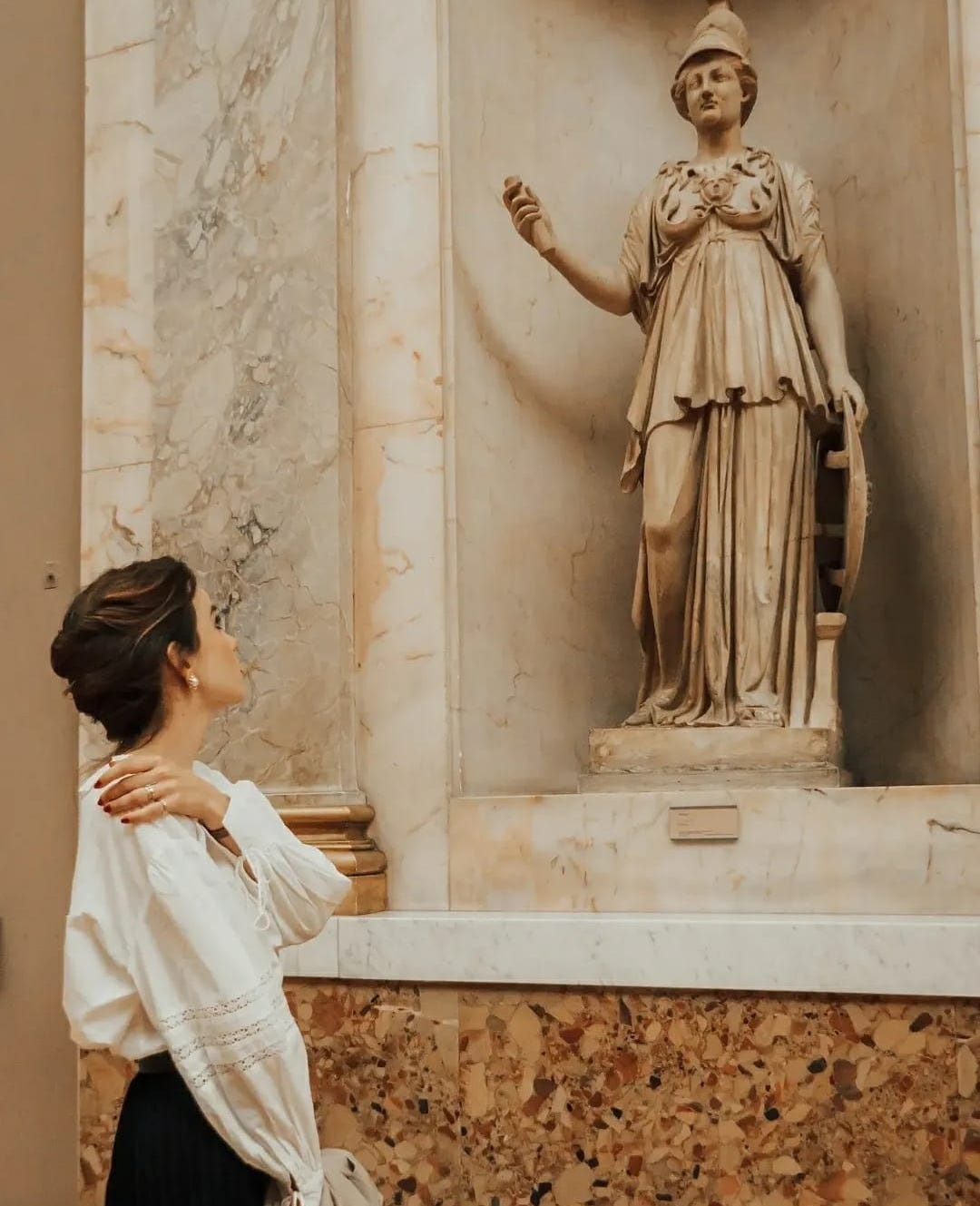
Have you had a good day? More importantly, have you lived it with style?
Glance at the watch upon your wrist. Whether time is your faithful companion or the incorrigibly hurried gentleman with whom you maintain a more complicated relationship, today we invite you to follow a woman who seeks to bring style to every hour of her day.
But first, what do we mean by style? We have already explored elegance as a matter of harmony that that touches every aspect of life. It’s what allows you to remain true to yourself, even as the hours change. What follows, then, is an invitation to dress your own hours in the same spirit, guided by the conviction that style reveals itself in the smallest details of everyday life.
We should also remind our dear reader that, just as Stefan Zweig titled his celebrated novel, if we are to follow twenty-four stylish hours in the life of a woman, we are following the day of a woman, not the woman. There are, after all, as many ways to live a day as there are women to live them, and no two days are ever quite the same. We would therefore be hard-pressed to write a book equal to the result of such an astonishing mathematical equation.
Just as the hands of a clock move ceaselessly onward, so our attention throughout this woman’s day rests upon the seamless flow from one activity and obligation to the next. We therefore offer these reflections mindful of the fact that no woman passes through her day dragging behind her a heavy trunk—or indeed an entire bathroom. Everything required for her style, we would suggest, ought to fit inside her beloved handbag. Is it not often said that a woman’s handbag contains her whole life? And for that very reason, one should never presume to search through it without her permission.
So let us set our heroine a challenge: to race against the clock without ever enjoying the luxury of returning home between the many engagements that fill her day. We shall see that she can emerge from this trial not only victorious, but impeccably stylish.
To that end, let us divide these twenty-four hours into four parts, just as we commonly divide the day by its four meals. For you will soon discover that style concerns far more than the clothes you wear. It extends to the appearance of your home, to the care devoted to cultivating your circles of family and friends—in short, to everything you see, hear, breathe, taste, and touch.
Night has now given way to dawn. Our heroine’s alarm has just sounded. And with the rising of this beautiful summer sun, our odyssey through the hours begins…
Our mission here at Letters from the Old World is to share the secrets of Old World elegance, and our approach is two-fold:
1) Every Wednesday, we send a free article exploring the theology and philosophy of why beauty matters, particularly in regards to decor and dress.
2) Every Friday, we send What’s In a Fit, a members-only article exploring practical tips and guidelines for dressing well.
If this resonates with you, then subscribe below to join the aesthetic renaissance.
I. The Domestic Hours
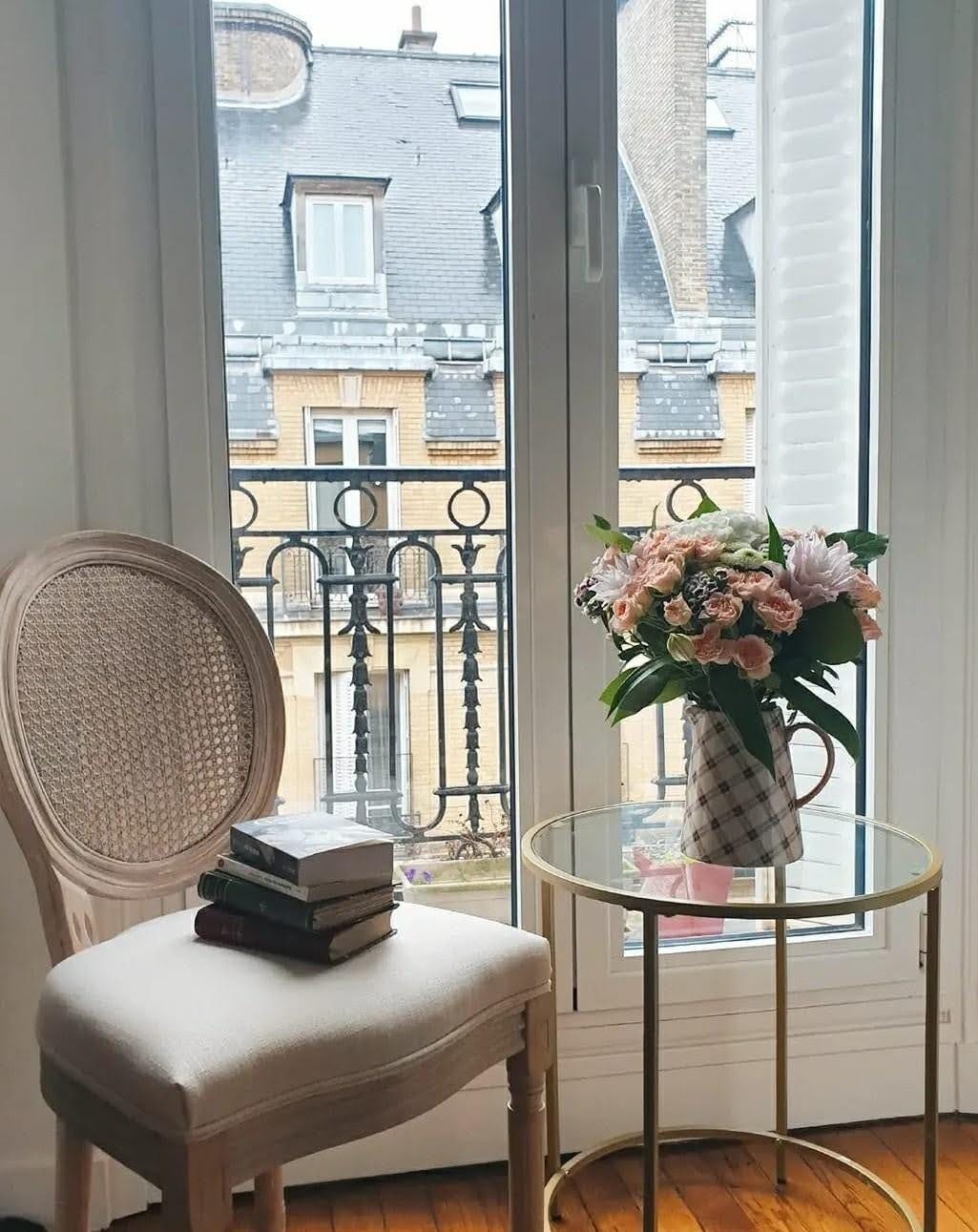
Tea or coffee? Our woman knows that upon waking the body asks for three things: hydration, warmth, and light. So first, a few sips of water to set the machine in motion. Then, a second measure of water, this time not for herself, but for the kettle.
What a lovely kettle it is. It may seem a small thing, yet choosing one that matched her cups and the soft green-striped kitchen towels when she first furnished this modest little kitchen is a pleasure she has given herself every morning since. Such tiny details belong to the realm of things no one is ever obliged to do. And yet that gentle shade of green repeated throughout her city apartment creates a kind of quiet tableau, one that is sometimes enough to restore good spirits after a restless night.
But whatever the night may have been, it is over now. Let us throw open the windows to welcome the fresh air and the morning light so essential to our well-being, and which make our homes more beautiful with each passing day.
She also knows, having read it often enough and confirmed it through experience, that the body emerges from sleep beneath an ancient surge of cortisol. Since she has no desire to place her day under the sign of unnecessary stress, she chooses a breakfast rich in simple proteins. Yesterday it was fresh cheese with almonds and fruit. This morning it will be scrambled eggs on whole-grain toast, served upon a plate striped in the very same green as her coffee cup (and her kettle).
And so, for the first time that day, both body and eyes are satisfied, while the house fills with the mingled scents of fresh air drifting in through the open windows and breakfast rising from the kitchen.
It is a gentle scene. Antique engravings depicting the pastoral life of the Grand Siècle adorn the tall white walls, their quiet elegance set against oak floors and a modern American-style range. The room itself is simple, almost spare, yet once again we see that beauty so often arises through contrast.
Upon her white wooden bedside table rests a small stack of unfinished books. We all know what it is to collect books forever begun, each one a promise of a world we never quite finish exploring. There are paperbacks whose pages she can dog-ear without too much remorse as they accompany her in her handbag, alongside handsome old editions with yellowed pages that seem to breathe the air of vanished centuries.
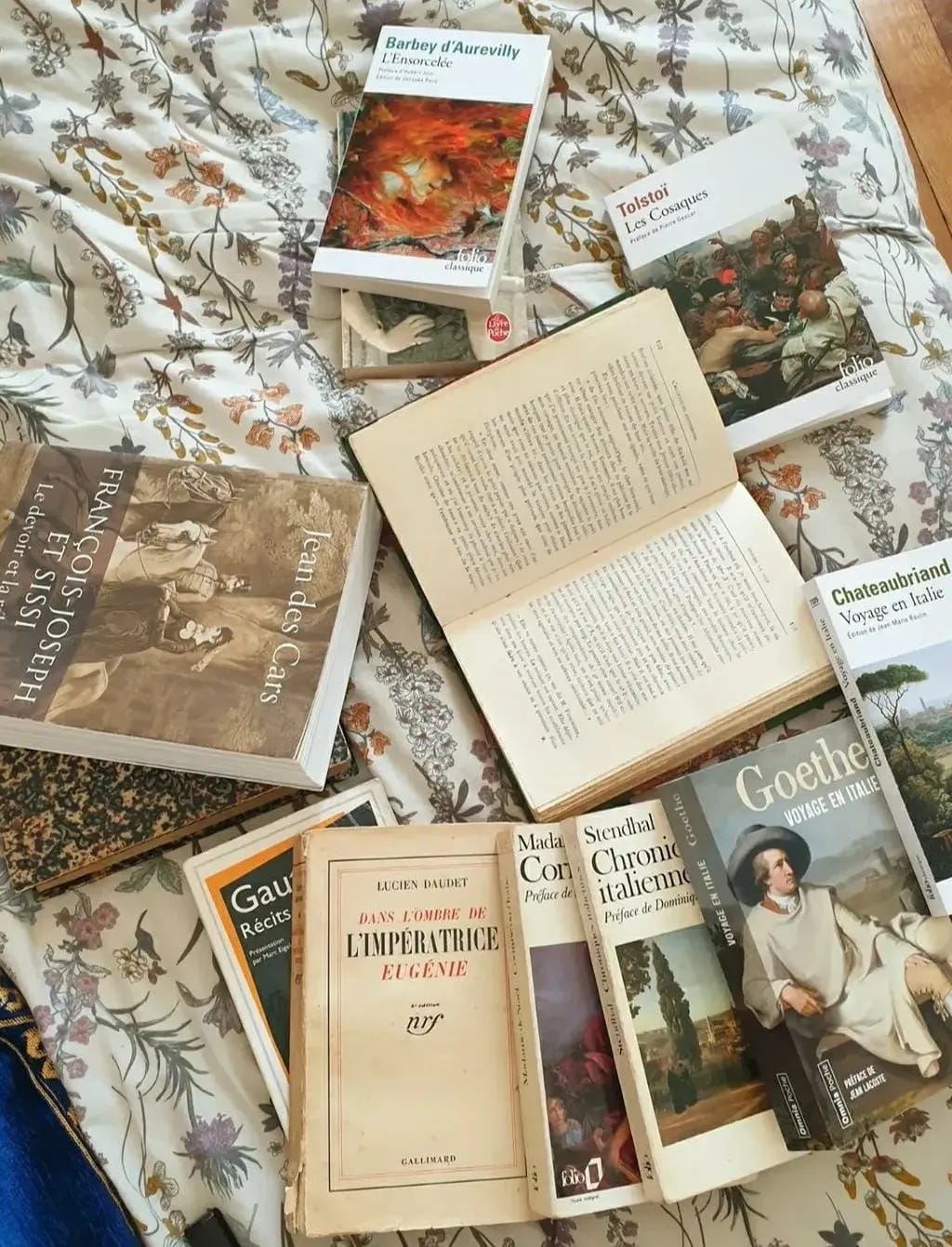
Among them rests an eighteenth-century edition of the works of Jean Racine, annotated in pencil by an unknown hand sometime in the 1860s. It was purchased less out of any urgent desire to read its contents than for the quiet delight of bringing home two traces of history at once: that of the great playwright himself, and that of the anonymous reader who encountered him generations later.
Our libraries, after all, are the wardrobes of our minds. We should want them to be eclectic yet harmonious, composed of both new and vintage volumes, but above all full of books chosen simply because they have captured our hearts.
II. The Busy Hours
But time is passing!
Speaking of wardrobes, what does our heroine’s day actually hold? The answer to that question determines another that concerns us greatly: What shall I wear today?
Like a well-crafted recipe, a successful outfit depends upon three essential ingredients: one’s schedule, one’s mood, and the day’s weather. Bring these three into harmony, and there is very little chance of making a sartorial mistake.
Today’s agenda includes several hours of work in the city center, an errand requiring a twenty-minute walk, a long-awaited reunion with a dear friend, and dinner afterwards. So she leaves in her wardrobe the towering heels reserved for formal occasions, along with that charming satin dress which, lovely though it may be, is hardly suited to a professional meeting, even if it would have been perfect for the evening’s social engagements.
Yet moving briskly through the city does not mean resigning oneself to flat shoes. A pair of leather sandals with a sensible five-centimeter heel offers exactly the right balance: graceful enough to flatter the leg, practical enough to keep pace with the day.
Another dilemma arises. Since we have challenged her to move directly from work to her evening plans without the luxury of changing clothes, how can one outfit serve both worlds?
The answer, once again, lies in contrast.
Certainly she would regret greeting her dear friend in an overtly corporate ensemble—a matching blazer and trousers paired with a sober blouse—even though modern tailoring offers many such outfits with undeniable femininity. But what if she simply separated the suit?
The trousers remain, while the blazer gives way during the workday to a romantic sky-blue blouse adorned with delicate floral motifs, perfectly suited to the beautiful summer day unfolding outside. She has not forgotten that these clothes must accompany her on foot beneath the July sun. The blouse is pure cotton; the trousers are woven from a blend of cotton and linen.
One brief stop at the ironing board is obligatory. Here again is one of those details that seems unnecessary, until one sees the difference. The same is true of slipping a leather belt through the belt loops, even though the trousers were never in danger of falling to her ankles.
She smiles, recalling Théophile Gautier’s famous preface to Mademoiselle de Maupin, in which he distinguishes beauty from utility. The belt is not there to hold up the trousers. To begin with, choosing garments properly fitted to one’s figure is among the first principles of elegance. More importantly, she has learned that defining the waist gives the silhouette its proper proportions and pays tribute to the beauty of the feminine form.
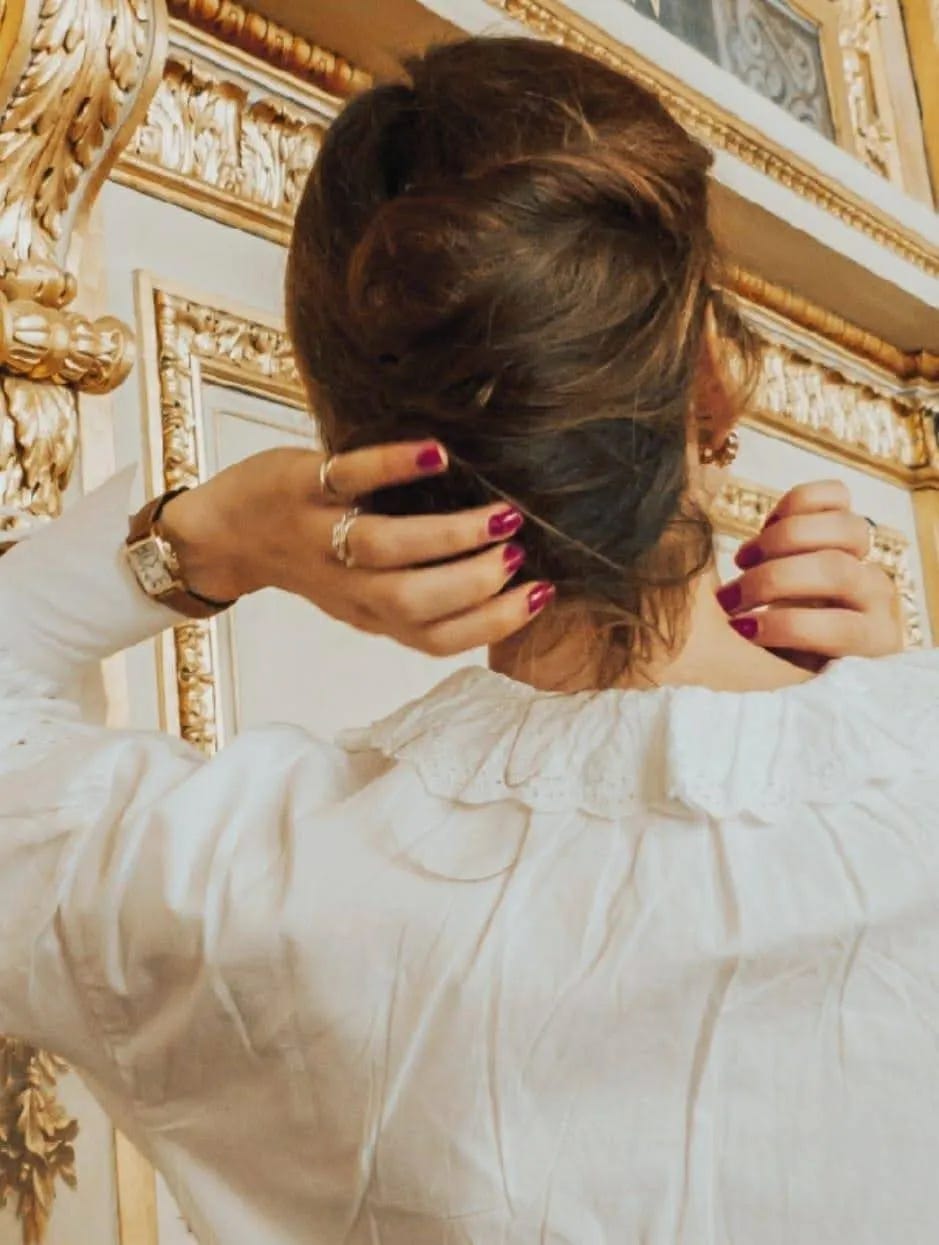
All that remains is to gather her hair into a chignon. A simple claw clip will do if time is short, while a handful of discreet pins can create the classic French twist that beautifully frames the profile, lengthens the line of the neck, and frees her from having to fuss with her hair twenty times before the afternoon is over.
A few drops of her favorite perfume, plus her cherished jewelry worn as a kind of personal signature. (We may return another day to the remarkable power of jewelry.) With that, she is ready for everything the day has in store.
But we can already hear the question forming: what of the evening, with its leisurely seated dinner, surely calling for attire a touch more refined?
Our friend, as it happens, has more than one trick tucked away in her handbag.
III. The Social Hours
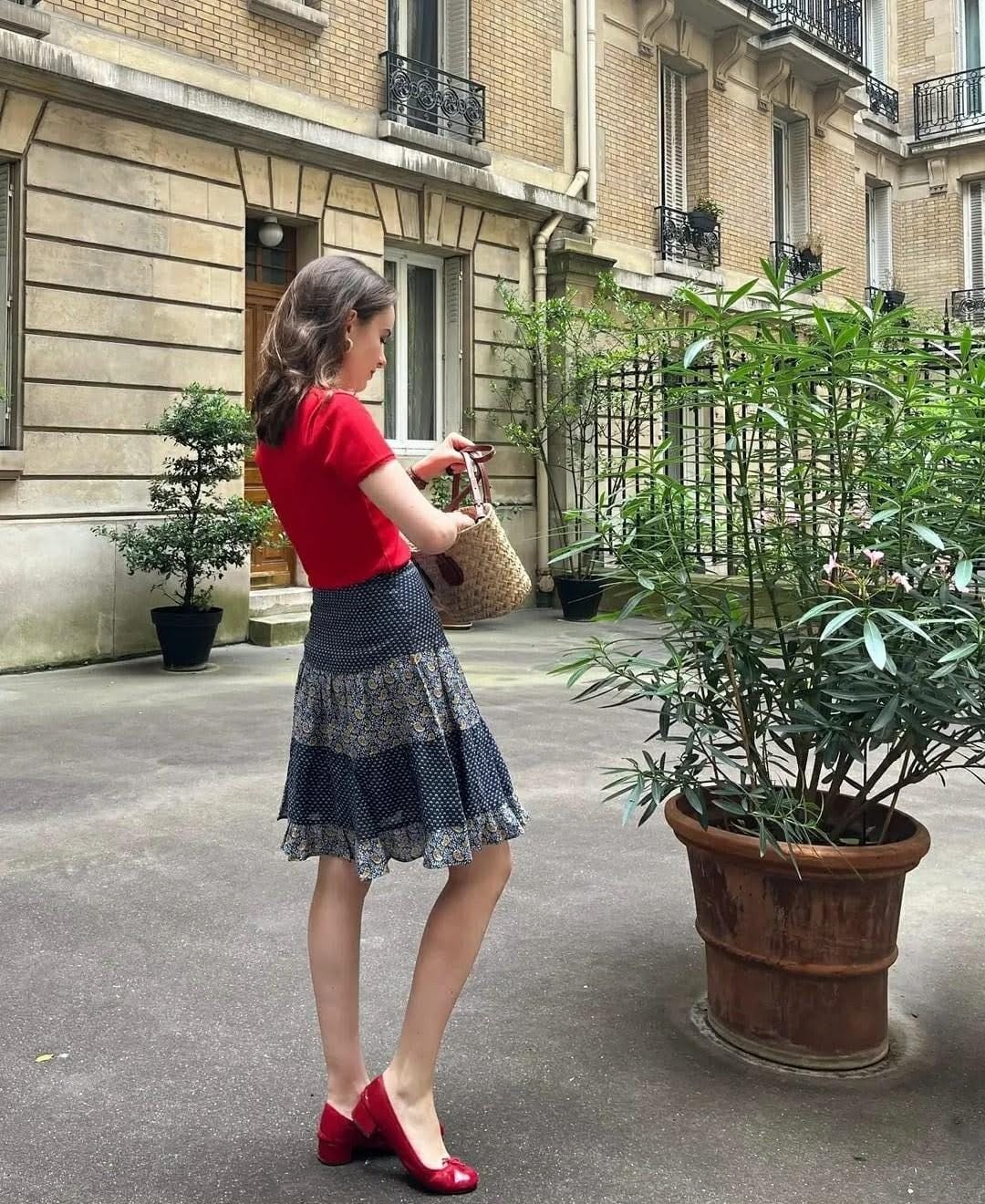
Fast forward, and the little hand of our protagonist’s watch has already begun its second circuit of the day.
The ordinary duties of work have been discharged, making way for an evening of leisure in a more festive atmosphere. If lunch consisted only of a light salad, freshly prepared at the café just around the corner from her office, it was because she had every intention of enjoying a richer dinner later: richer both in nourishment, and in delight.
And here, at last, is the answer to the question we posed earlier: if an evening out calls for attire more elegant than that of the workplace, what is one to do?
“It depends upon the dress code,” you may say.
Certainly. But that is not the case here. Evening belongs to a different world than day, and marking that transition—however unnecessary it may first appear—plays no small part in rest, renewal, and the simple joy of living.
This is precisely the idea behind what sociologists have come to call the Third Place: that setting which is neither home nor workplace, but a space where one is free to become another version of oneself. Distinguishing this third sphere from the first two is also the perfect opportunity to step into an entirely different mode of dress.
Had she been able to return home, she would no doubt have exchanged her blouse and trousers for that little satin dress and a pair of high heels. But what is one to do when the luxury of that stylish interlude is denied?
