



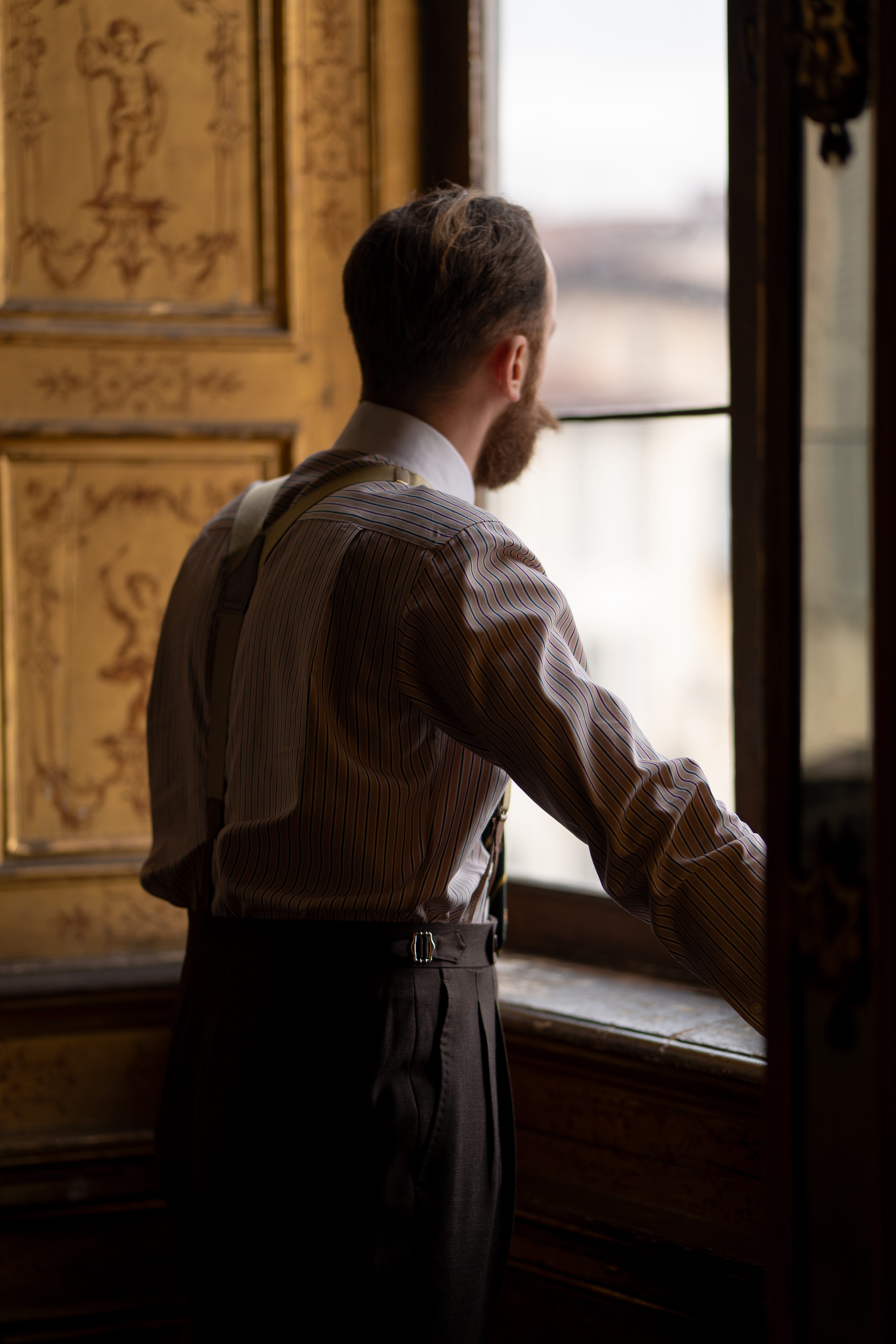
In the Sermon on the Mount, Christ preaches that you should not concern yourself with “what you will eat or what you will drink, nor about your body, what you will put on.” Clearly the message is that food, drink, and clothing do not matter, right?
It’s a straightforward interpretation, one that many Christians accept.
But what most people miss is that Christ doesn’t forbid caring about clothes or gratitude for beauty; he instead warns about something else entirely. While unintentional, this misunderstanding can, at its worst, be used to justify a false asceticism or make looking unkempt seem like a scripture-backed way of life.
Today, we explore what Christ really says about clothing in the Sermon on the Mount. If you’ve ever worried that your care for clothes could lead you away from God, read on…
Matthew 6:25-31 In Context
“Therefore I tell you, do not be anxious about your life, what you will eat or what you will drink, nor about your body, what you will put on. Is not life more than food, and the body more than clothing? […]
And why are you anxious about clothing? Consider the lilies of the field, how they grow: they neither toil nor spin, yet I tell you, even Solomon in all his glory was not arrayed like one of these. But if God so clothes the grass of the field, which today is alive and tomorrow is thrown into the oven, will he not much more clothe you, O you of little faith?
Therefore do not be anxious, saying, ‘What shall we eat?’ or ‘What shall we drink?’ or ‘What shall we wear?’”
First, an important piece of context. For the people Christ was preaching to, the necessities of life were not guaranteed. Unlike you and me, they could not walk into a store and buy everything they needed to live.
Clothing in particular was also more valuable back then. It was made by hand, and the average person didn’t own more than a few outfits total. What clothes they did have were considered precious, and replacing them would have been far more difficult and costly than it is today. Consider the parable of the Good Samaritan, where a man “fell among robbers, who stripped him and beat him and departed, leaving him half dead.” Notice that the only thing we’re told he’s robbed of is his clothing? How many robbers today would even bother to strip people of their clothing? Clothes are so inexpensive and abundant now that it’s not (usually) worth stealing them.
The point is that clothing was a much bigger deal 2000 years ago than it is for the average Westerner today. Therefore, when you read this passage, keep in mind that Christ’s audience were more worried about whether they could get clothes rather than what kind of clothes they could get.
Christ Condemns Anxiety, not Discernment
Many writers have tackled the aforementioned passages and come to the same conclusion: Christ is addressing the anxiety of securing life’s necessities, an anxiety that would have been natural to his followers at the time.
For example, commentary on Matthew 6:30 in Johann Albrecht Bengel’s Gnomon of the New Testament states that the concern is with whether you will be clothed, not with what:
In this life few attain to the adornment of Solomon, not to mention that of the lilies; our Lord’s words, therefore, regard the certainty, not the degree of adornment: but in the life to come we shall be more adorned than the lilies. We ought not, however, altogether to reject adornment in things, however perishable.
Likewise, commentary found in the Ignatius Catholic study bible states:
God supplies our physical needs to signify his greater concern for our spiritual needs. As his care for the lilies and the grass is outmatched by his provision of clothing for us, so the garments we receive prefigure God’s desire to clothe us with glory and immortality in heaven. […] Christians must prioritize the pursuit of holiness in their lives. This is not an excuse for laziness in practical matters but a call to trust in the Father’s care.
Different translations of passages like Matthew 6:31 (Therefore do not be anxious, saying, ‘What shall we eat?’ or ‘What shall we drink?’ or ‘What shall we wear?’”) also make this plain. Consider, for instance:
“So do not start worrying: ‘Where will my food come from? or my drink? or my clothes?’”
-Good News Translation
or
Don’t worry and ask yourselves, “Will we have anything to eat? Will we have anything to drink? Will we have any clothes to wear?”
Contemporary English Version
Taken together, it’s clear that the fear of lack is the main anxiety Christ is addressing.
Where Your Treasure Is, There Your Heart Will Be Also

This is not an argument against ascetic tradition, which holds great spiritual benefits, nor is it an endorsement of vanity, an obvious sin. The problems with materialism are clear: in Matthew 6:19-21 Christ instructs you to not seek treasures on earth where moth, rust or vermin destroy them, or where thieves can steal them from you.
Instead, you should gather up your treasures in heaven, where none of these corrupting forces can reach them. This is a necessary addendum to everything that we’ve covered today, as it directly relates to our topic. Moths, after all, would have been pests for eating up textiles used in clothing.
So while beautiful clothing can indeed be beneficial, for reasons we’ve outlined elsewhere, it would be better to burn your wardrobe than allow it to become an idol, or a “treasure” valued above your soul, “for where your treasure is, there your heart will be also.”
But assuming that clothing is not an idol for you, then how should you approach how you dress?
Abundance, to What End?
If you’re reading this, odds are you are not living a life of subsistence like Christ’s first disciples. You’re likely living in a country where you don’t have to worry about where you will be able to find clothes. This material abundance can make us feel that we do not need to rely on God for the necessities.
If that is the case, then consider yourself blessed. Few people in history have been given as much. Just remember that “from everyone who has been given much, much will be demanded; and from the one who has been entrusted with much, much more will be asked.”
Recall as well the parable of the talents, where a man traveling to a distant country entrusts three of his servants with five, two and one talent respectively. While the first two servants find ways to double the amount they were given, the last servant buries his share for fear of losing it altogether. Upon the man’s return, he congratulates and rewards those who used what they were given wisely, but casts out the servant who had refused to invest his talent.
There is a clear expectation from God that from those who have been given much, he expects much. If you are entrusted with something of great worth, you are expected to make something of it. The spiritual implications of this are profound, of course, and take priority. The application to dress is, at most, a tertiary consideration.
But once you have set your spiritual house in order, then consider how you are using the abundance God has given you. Once provision of resources is no longer a worry, then you should concern yourself with their proper use and stewardship instead. You have been blessed with a dizzying array of apparel from which you can fill your closet. Does what you chose to wear reflect the beauty, respect and gratitude that such a gift from God expects? Or do you reject the proper stewardship of this abundance? If God clothed the lilies of the field in beauty, how much more would he want that for the creation he made in his own image?
God has entrusted you with more resources than most humans in history ever had, therefore the expectation is equally great. You have the resources to dress properly, to dress in a manner that injects beauty into your life and the lives of those around you.
So ask yourself: will you bury your talent, or rise to the occasion?
As a reminder, our mission here at Letters from the Old World is to share the secrets of Old World elegance, and our approach is two-fold:
1) Every Wednesday, we send a free article exploring the theology and philosophy of why beauty matters, particularly in regards to decor and dress.
2) Every Friday, we send What’s In a Fit, a members-only article exploring practical tips and guidelines for dressing well.
If this resonates with you, then subscribe below to join the aesthetic renaissance.
This was food for thought on a topic I’d been thinking about a lot lately. Thank you.