

Fashion vs. Style
The war between two philosophies...



Though fashion and style share many similarities and can refer to the same ideas, to use them interchangeably limits your ability to think properly about personal aesthetics. This is because while most people think they refer to the same concepts, the philosophies that ground fashion versus those that ground style are significantly different.
To say that someone is fashionable is to say that they are up to date with trends; they have an eye on what the world is wearing and dress to fit. It relates to industry rather than to the person. To say that someone is stylish, however, is saying something deeper about their intentions.
While it can mean they are aware of current trends, it is not necessary for the stylish person to wear the bleeding edge couture found in fashion capitals. Rather, the stylish person is someone who crafts their appearance using a combination of aesthetic understanding and deeper values.
Today, we explore the hidden chasm between fashion and style, the values inherent in each of these concepts, and how knowing the difference between them can help you mold a personal aesthetic rooted in something good, true and beautiful…
Our mission here at Letters from the Old World is to share the secrets of Old World elegance, and our approach is two-fold:
1) Every Wednesday, we send a free article exploring the theology and philosophy of why beauty matters, particularly in regards to decor and dress.
2) Every Friday, we send What’s In a Fit, a members-only article exploring practical tips and guidelines for dressing well.
If this resonates with you, then subscribe below to join the aesthetic renaissance.
An Etymological Starting Point

Knowing where the words “fashion” and “style” come from is helpful in separating them from each other. It also reveals why using them synonymously robs your language of useful nuance.
Fashion finds its origins roughly 800 years ago in Latin words like facere, which means to make. From there, it flows into factionem, which also refers to doing or making, to old French’s façon, which keeps the emphasis on creation while growing to include meanings like the face and appearance of something, and then again to fasoun, describing the form, shape, or appearance of a thing.
You can see that fashion thus has roots in both the making of a thing as well as the appearance of it, dual meanings which find their synthesis in the idea of the fashion industry. Thus fashion, for the purposes of this piece, refers to the industry it has built as well as the downstream effects it engenders, including cycles and trends. Fashion today is about the infrastructure built around the manufacturing, buying and selling of clothing, which necessitates the cycles of churn that mean “fashionable” people must continually purchase new clothing in order to remain fashionable.
As for the word style, its origins are equally salient. Starting with the Latin word stilus, which refers to a writing instrument, manner of writing, or mode of expression, in old French it becomes stile, a fashion or manner. Its use in English also begins with the notion of a writing implement, then turns into a person’s particular mode of expression while writing, and later broadens out to all manner of personal, external presentation.
Even today, we find that style still retains its reference to the modes of expression of an individual. Just as the stylus from which it takes its name allows you to make your signature, so does style allow you to make your mark with your look. You would say someone has a personal style, but you’d be far less likely to say they have a personal fashion for this reason.
Acknowledging once again that the two terms in question are often used interchangeably — “they are fashionable” often means the same as “they are stylish” — the point of sharpening the distinction allows for greater accuracy, and should be encouraged. Thus, “they are fashionable” when used with more precision means the person follows fashion trends or the fashion industry, while “they are stylish” means that the person understands how to dress well, regardless of if their attire is fashionable or not.
While this may seem like splitting hairs, seeing the difference is crucial for how you think about presenting yourself.
Fashion is a Trap

The reason for the constant change of fashions, which has now become seasonal — changes which are slower in basic lines, but extremely rapid in secondary variations — seems to be a desire to surpass the past. It is facilitated by the frantic character of the present era, which has a tremendous capacity for burning up in a short time all that is meant to satisfy the fantasy and the senses.
–Pope Pius XII
The reason to draw out the concepts of fabrication and industry in the idea of fashion is to understand why you should be wary of it. When it comes to figuring out what to wear, fashion should not be your go-to. Fashion is a system that by its nature creates and promotes dissatisfaction with what you have, demanding constant novelty from its creators. It also promotes conspicuous consumption, selling clothing as ephemeral status signifiers which are relevant today and déclassé a year from now.
The drive behind fashion comes from outside yourself, and is dictated by people whose morals and goals are, at best, unknown to you. A great example of this occurred at the tail end of the skinny jean era when designers started filling the catwalks with models in wider-legged jeans. Those whose job it is to predict culture — coolhunters and trend forecasters like WGSN — spotted the new look and alerted their fashion retailer clients to begin conditioning customers to want wider legged pants.
Soon enough, those retailers introduced mom jeans, and when those caught on, wide-legged pants, and now the fashion forward are sporting ultra-wide looks that will eventually go out of style themselves. The channel Maxinomics did a fantastic breakdown of this process here if you’re interested in learning more.
This is fashion. The hunt for cool, for status, for novelty. Its goal is not to keep up with the Joneses, but to be the Joneses you envy. Fashion wants you comfortable in your clothes only as long as they haven’t figured out the next thing they want to sell you.
In short, they want you focused on what others wear and feeling discontent with what you have. The complete opposite of what people like St. Paul say provides real contentment:
I know what it is to be in need, and I know what it is to have plenty. I have learned the secret of being content in any and every situation, whether well fed or hungry, whether living in plenty or in want. I can do all this through him who gives me strength.
–Philippians 4:12-13
So, if you’re sufficiently disenchanted by all this and want to escape the hedonic treadmill that is fashion, you need to understand style.
Style is the Solution
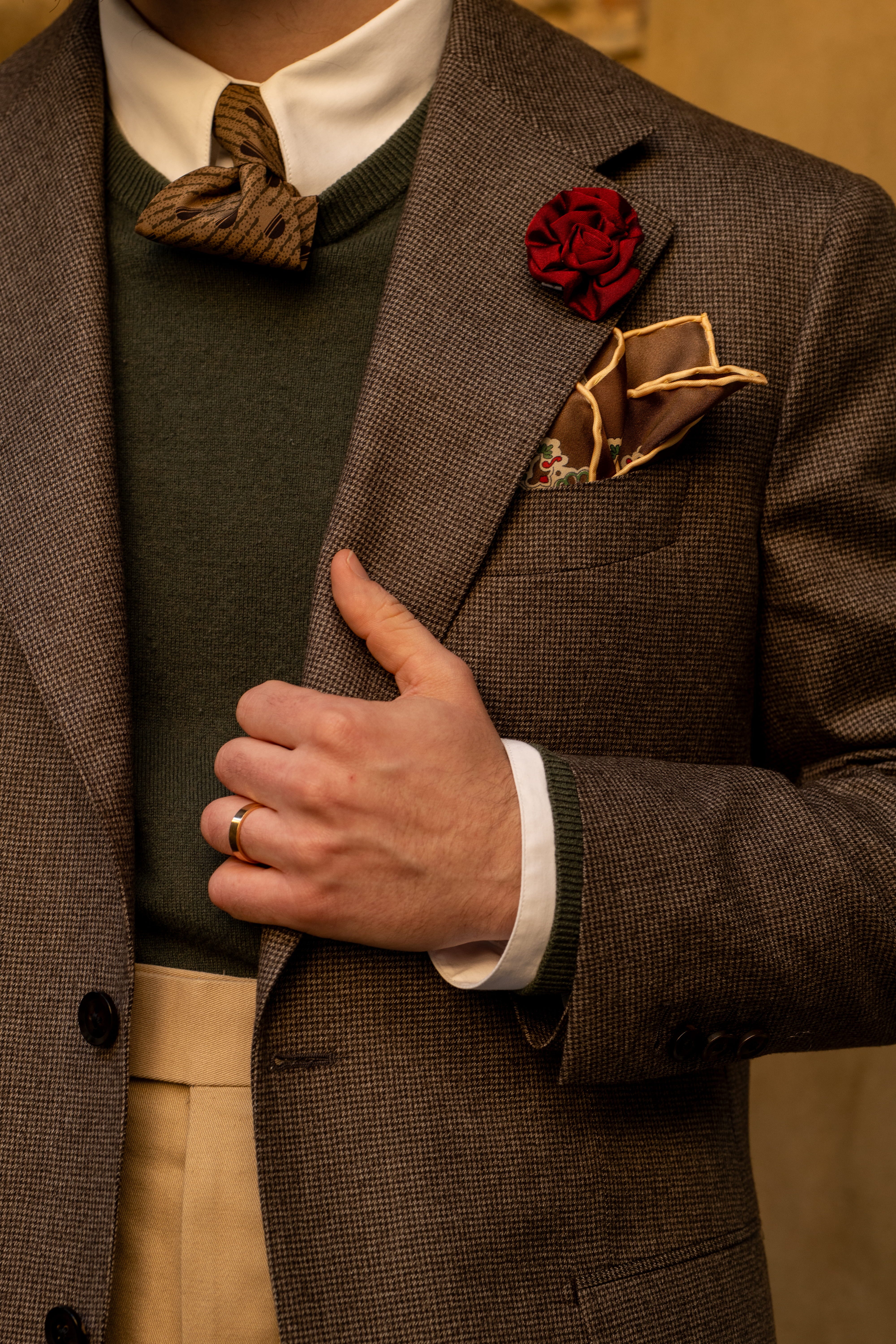
By misconstruing fashion and style, we lose the meaning, purpose, and significance of both. […] It is especially important to note the significance of personal style because it is a sign of being made in the image of God.
–Lillian Fallon, The Theology of Style
If fashion is eternally driven and motivated, style is its mirror opposite. Style refers to your signature, a display of your personal “brand.” It is meant to showcase your beliefs, your understanding of aesthetics, and be your contribution to the beauty in the world. When a stylish person is fashionable, it’s likely that the fashion just happened to fit into their style.
Style is a risk. It is the opposite of an insecure conformity. It can single you out as someone who rejects or disregards both the values and consensus of the fashion industry. It is an act of self-confidence to rely on your own understanding of what is true, beautiful, and good. When that understanding is properly formed and based on solid ground, you don’t need to chase after what others are doing or wearing.
In Ralph Waldo Ermerson’s essay Self-Reliance, he suggests that envy of others is a form of ignorance, and that imitation is a suicide, usurping yourself in favour of another’s ideals. For Emerson, to do as others do when it entails acting against your instinct is to betray your nature and bury the talents that God had bestowed on you. In doing so, he says, you refuse the part God intends you to play and sow discord in your heart:
We but half express ourselves, and are ashamed of that divine idea which each of us represents. It may be safely trusted as proportionate and of good issues, so it be faithfully imparted, but God will not have his work made manifest by cowards. A man is relieved and gay when he has put his heart into his work and done his best; but what he has said or done otherwise, shall give him no peace.
When it comes to style, then, expressing your own, not that of trend hunters or industry insiders, is a far better approach to living with integrity and the dignity that comes from being made in God’s image.
The Final Step to Style

Costly thy habit as thy purse can buy,
But not express’d in fancy; rich, not gaudy;
For the apparel oft proclaims the man.–Hamlet, Act I, Scene III
If there is one takeaway from all this, it’s that you shouldn’t let external pressures influence what should be a deeply personal process. If you don’t know where to start, just avoid taking cues from those who want you in an endless cycle of clothing consumption. Instead, do some research not on what’s trending, but on what has stood the test of time.
Once you’ve learned to separate solid style advice from fashion’s fickle influence, you’ll be able to dress in a way that both shows who you are and what values you live by. Where others enviously pursue the latest fad and cast their attention outwards, you can forge your own path, one guided by something greater than trend forecasts.
Fashions come and go like the tide, but if your understanding of appearance is rooted in the eternal, then your style’s foundation will be as solid as they come.
I love this. I grew up without much sense of style—or even “fashion,” for that matter—and this article describes very well the journey I’ve been on the past year or so to intentionally develop and curate a personal style. Understanding the difference is so important to building a wardrobe that will last.
I appreciate the etymology section! I think I realized the distinction, I just never use it. I will be more intentional now. Thank you!