




Our modern conception of beauty aims at the perfect, the symmetrical and the unblemished. We speak of beauty in a Botticelli, Brahms or mountain-ringed vistas, and while these are indeed beautiful, they don’t tell the full story. What many are missing is the transformative power of the imperfect, the scarred and the broken.
Where most today seek out comfort and positivity in the beautiful, thinkers, theologians, and philosophers have long understood that there is beauty in pain, in wounding, and in the flawed. In fact, without these things, beauty cannot be experienced in its fullness.
This shadow side of the beautiful is neglected for many reasons, but once you understand it, you’ll have a better grasp of what truly makes something beautiful. You’ll also begin to find the transcendent in places few ever think to look…
Our mission here at Letters from the Old World is to share the secrets of Old World elegance, and our approach is two-fold:
1) Every Wednesday, we send a free article exploring the theology and philosophy of why beauty matters, particularly in regards to decor and dress.
2) Every Friday, we send What’s In a Fit, a members-only article exploring practical tips and guidelines for dressing well.
If this resonates with you, then subscribe below to join the aesthetic renaissance.
Smoothing out the Sublime
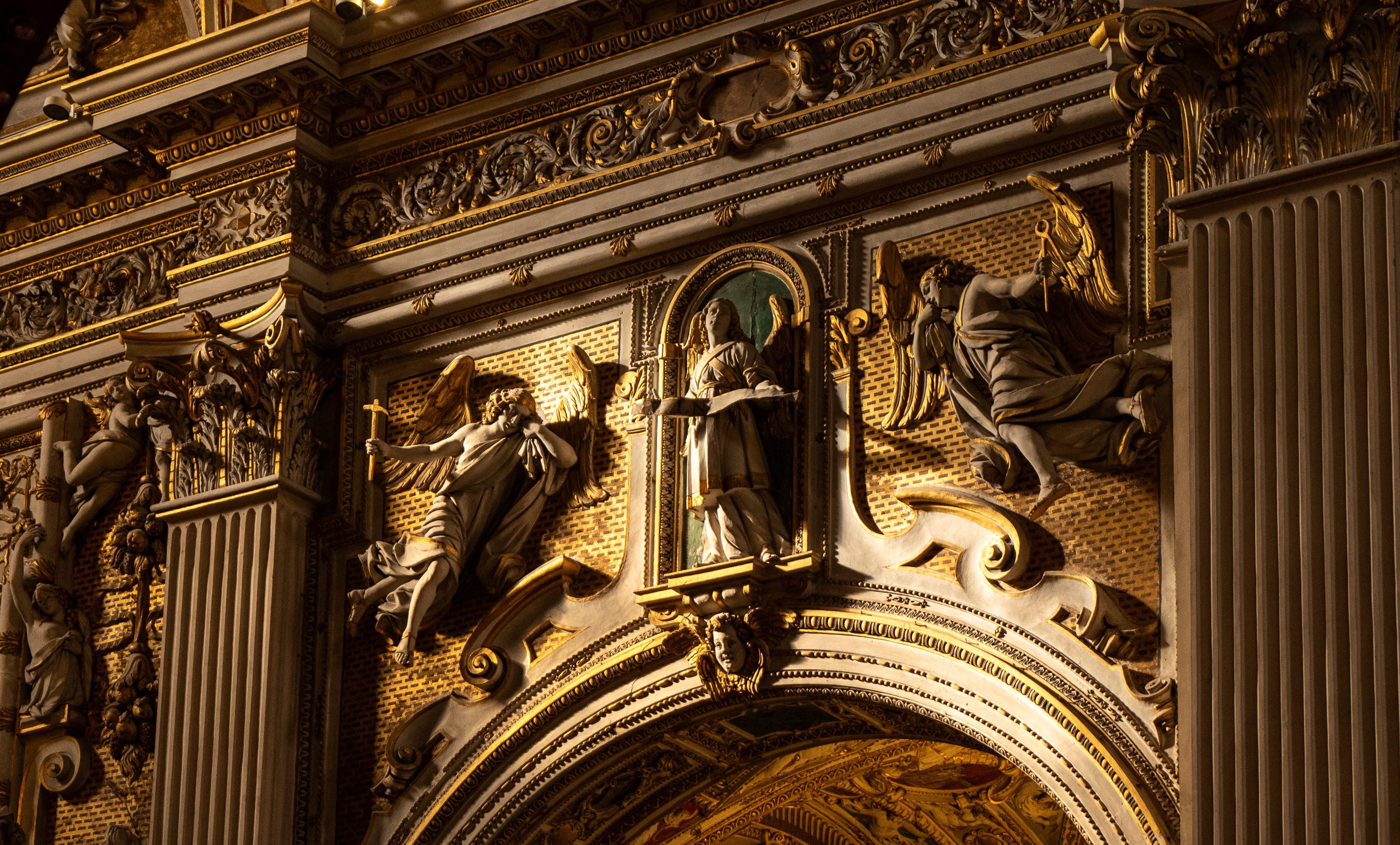
For beauty is nothing but the beginning of terror which we are barely able to endure, and it amazes us so, because it serenely disdains to destroy us.
–Rainer Maria Rilke
In Saving Beauty, philosopher Byung-Chul Han argues that “smoothness” is the problem with the modern understanding of beauty. For him, smoothness means that which puts up no resistance to the viewer. It is the frictionless, the easy, the unchallenging, “something one just likes.”
The smooth is the signature of the present time. It connects the sculptures of Jeff Koons, iPhones and Brazilian waxing. Why do we today find what is smooth beautiful? Beyond its aesthetic effect, it reflects a general social imperative. It embodies today’s society of positivity. What is smooth does not injure. Nor does it offer any resistance…The smooth object deletes its Against. Any form of negativity is removed.
Negativity as Han uses it means a wound of sorts. It confronts, imposes, or shocks you in a transformative way. It echoes Rilke’s Archaic Torso of Apollo: “There is no place that does not see you. You must change your life.” Negativity is the small terror, the challenge that knocks you over when witnessing the sublime. It encompasses the paradox, the contradiction, the painful.
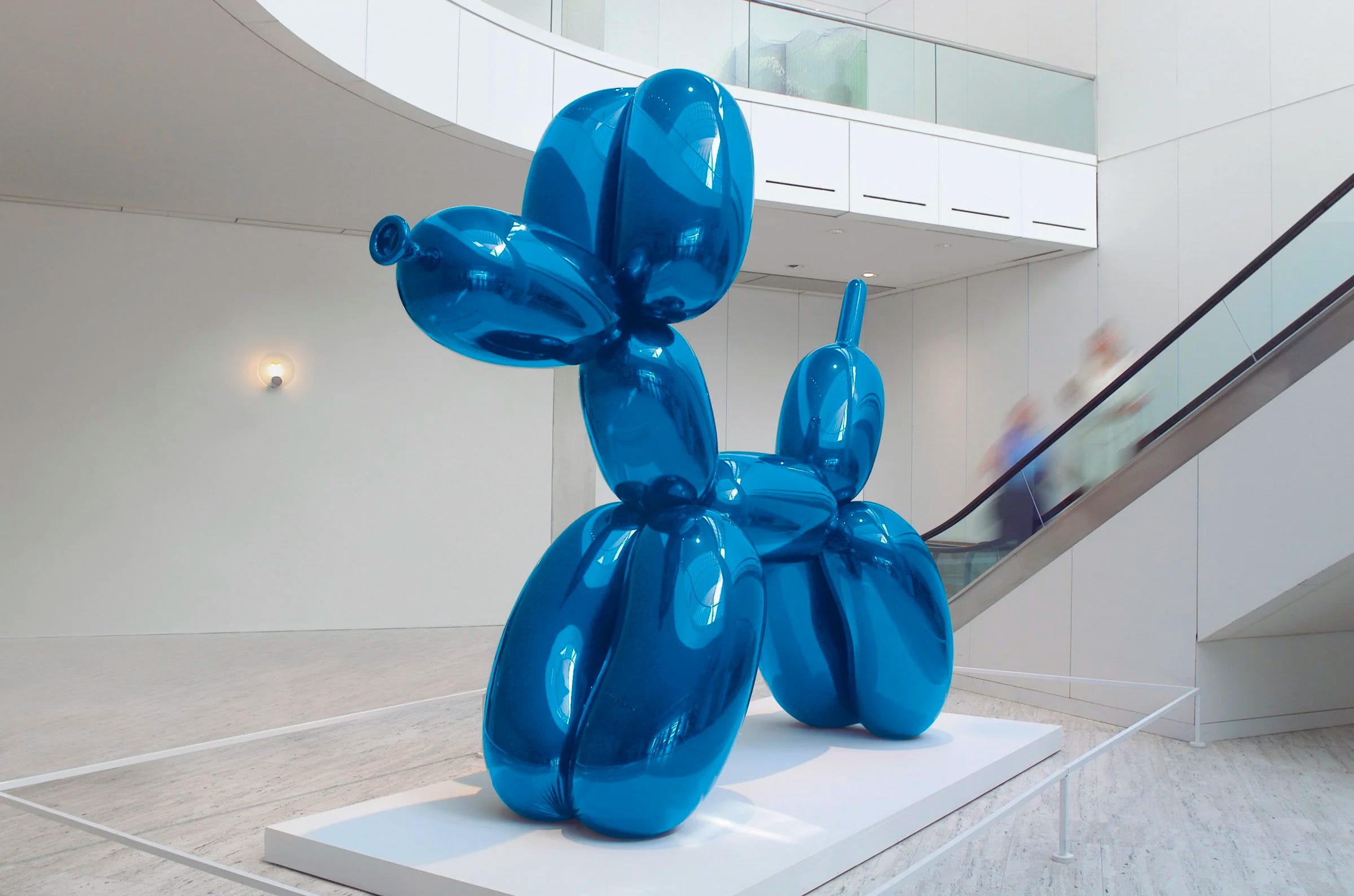
Unfortunately, beauty today has been separated from the sublime in favor of a beauty of positivity. Han sees the artist Jeff Koons as an embodiment of this new, smooth beauty. Koons is famous for his pop art, which Han describes as having “no disaster, no injury, no ruptures […] Everything appears rounded, polished, smoothed out.” Koons hopes for his work to please his audience and leave them unburdened. You are not wounded by beauty in his work because that would distract from the immediate pleasure Koons wants to share. But wounding is necessary for true beauty, says Han:
The healthy is a form of expression of the smooth. Paradoxically, it radiates something morbid, something lifeless. Without the negativity of death, life solidifies into something dead. […] Negativity is the invigorating force of life. It also forms the essence of beauty. Inherent to beauty is a weakness, a fragility, and a brokenness. To this negativity, beauty owes its power to seduce.
Han argues that to save beauty, you must reunify the beautiful with the sublime. To marry the two together is to return a transcendent element to beauty, to create an uncomfortable friction or distance between the viewer and the viewed. In this space there is challenge, wounding and recognition of imperfection. These confrontations demand you transform into something greater than what you are.
Sacred Scars
There are few examples of beauty married to sublime wounding as overt as the story of Christ’s crucifixion. If you’re living in the West, you may have grown numb to how unusual seeing a crucified man hanging on the wall should be. This was an act of torture and death, subverted and transformed into the ultimate act of love.
There’s a particular devotion to the wounds of Christ that speaks directly to the relationship between the broken and the sublimely beautiful. In 2018 Pope Francis spoke of this devotion, saying that meditating on the wounds through prayer can lead you to a richer understanding of the transcendent:
I may think: “How do I look at the Crucifix? As a work of art, to see if it is beautiful or not? Or do I look within; do I penetrate Jesus’ wounds unto the depths of his heart? Do I look at the mystery of God who was humiliated unto death, like a slave, like a criminal?”. Do not forget this: look to the Crucifix, but look within it. There is a beautiful devotional way of praying one “Our Father” for each of the five wounds. When we pray that “Our Father”, we are trying to enter within, through the wounds of Jesus, inside his very heart. And there we will learn the great wisdom of the mystery of Christ, the great wisdom of the Cross.
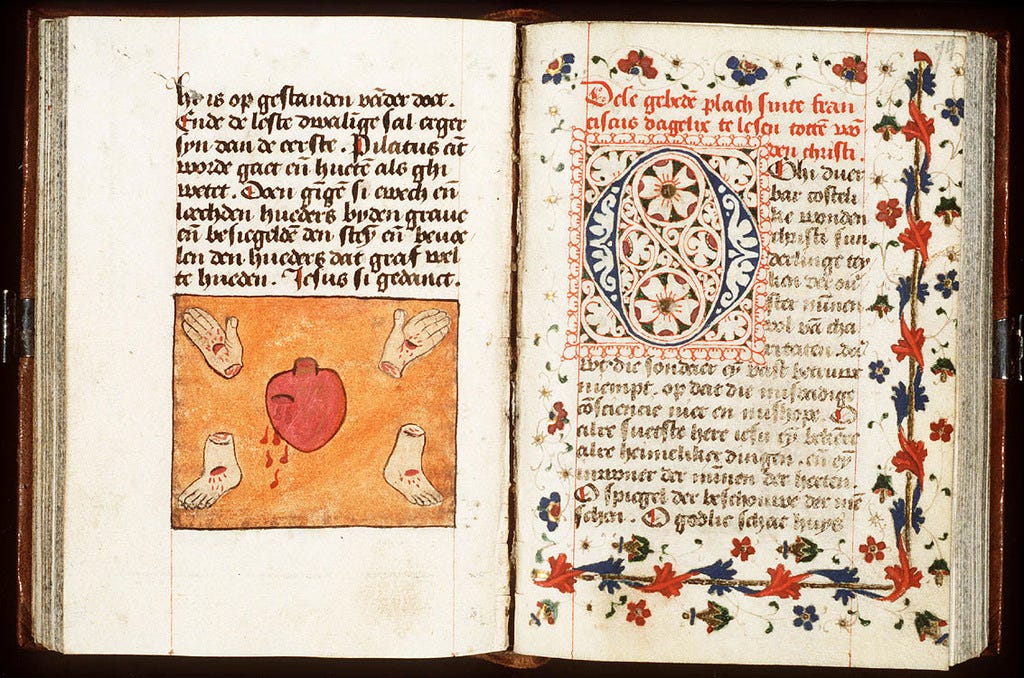
Medieval depictions of Christ wounds rendered them as large, red almond shapes on the page. These images confront you in both their yonic symbolism and their depictions of torn flesh, perhaps the most recognizable icon of suffering we have. They are the embodiments of the Christian paradox, that you must lose your life to gain it. Yet these wounds invite us to transform ourselves via suffering.
To focus on the wounds of Christ and see them as worshipful is to reflect on the subversive nature of the Christian story. To take the Cross, an object of death and torture, and make it the ultimate symbol of eternal life and hope. This is a perfect embodiment of the sublime aspect of true beauty, one that terrifies in both form for what it shows and concept because of what it demands of you.
The demanding and transcendent offer one approach to the beauty of brokenness. But there are concepts outside the Western tradition that offer another. The sublime is not always the overwhelming encounter. Sometimes, it’s a quiet acceptance of impermanence, a melancholic, spiritual longing.
Golden Repairs
Are we to look at cherry blossoms only in full bloom, at the moon only when it is cloudless?
–Kenkō, Essays in Idleness
Japanese aesthetics draws on a separate tradition from Western understanding, but in recent years it’s drawn increasing interest for its novel propositions. One such proposition is the idea of Wabi Sabi, which seeks out and affirms the beauty in the imperfect and the impermanent.
The concept is a marriage of two terms: Wabi, which encompasses austere, empty beauty, adequacy and the moderate; and Sabi, which denotes desolation, aging well, rust and the acquisition of patina, all of which confer a type of beauty. Taken together, Wabi Sabi becomes an aesthetic appreciation of asymmetry, wear, roughness, and austerity.
In Wabi Sabi: The Japanese Art Of Impermanence, author Andrew Juniper writes that Wabi Sabi can be seen in “the small nuances of color, the curve of an opening petal, the crack in a bamboo vase, or the decay of a knot in old timber.” Such objects produce within you a spiritual longing and a serene melancholy. But rather than a self-indulgent self-pitying brought on by the impermanence of things, it is instead “a sadness tinged with longing.”
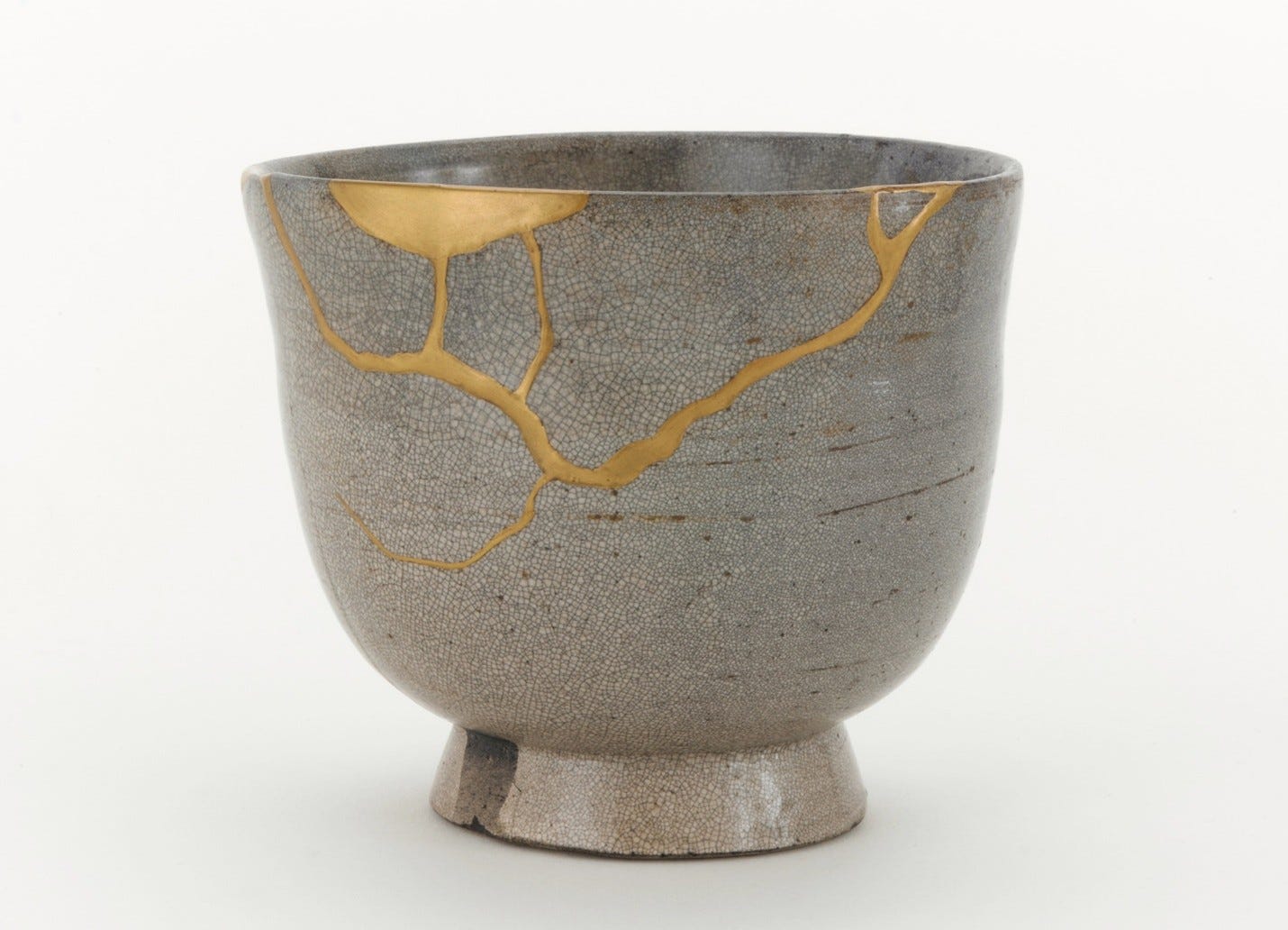
A wonderful instantiation of Wabi-sabi is the art of Kintsugi, the repair of broken items with the use of gold. Kintsugi emphasizes the damage the repaired object has suffered as a part of its beauty. Rather than hide reminders of impermanence, the practice invites you to see the chaotic lines and chips of the ceramic as additions, not subtractions, to the aesthetic of the object. In doing so, it says something profound about how you should approach aesthetics and life itself. It is not simply a perfection of forms, but an appreciation of the experiences, good or bad, that it undergoes through time.
Whether it’s the wounds of Christ, the cracked vase or Rilke’s sublime terror in the face of Apollo, the meaning is the same; damage can mean destruction, but it can also be a profound source of the beautiful.
The Power of Your Imperfections
Han’s diagnosis remains true to this day. Beauty has been stripped of its fullness, of the sublime and its terrifying wonder. But you can bring its wholeness back by embracing the roughness, the scars and the cracks in your own life. Not as hindrances, but as pathways to a different understanding of beauty. One that loves the aged patina of a leather jacket as much as the chip made in a family heirloom or the scars you earned living your life.
There is of course a time and a place for the perfect form, the Platonic ideal and the pleasantly beautiful. We need more of these in a world that feels sapped of its wonder. But when you learn to love through the wound, you deepen your compassion. When you learn to gild the cracks in the world, you increase your ingenuity. When you seek out the rough instead of the artificially smooth, you reclaim something of the sublime.
When you welcome the fractured as an element of your aesthetics, you’ll find beauty not despite flaws, but because of them.
I would say the broken parts are what makes people and things beautiful. Sounds trite, but when you really dwell on it, it’s true and I think this article captures that beautifully.
There is so much beauty in these reflections. As I read about kintsugi, what occurs to me for the first time in my life is that the gold is like a symbol of the grace of God Christ won for us that repairs our wounds and makes these broken vessels more than they were before. Thank you for an excellent piece.