


Editor’s note: Today’s article is by Aliénor Mathé, a jewellery designer in Paris. It has been translated and adapted from French. If you would like to read more from Aliénor in the future, let us know in the comments.
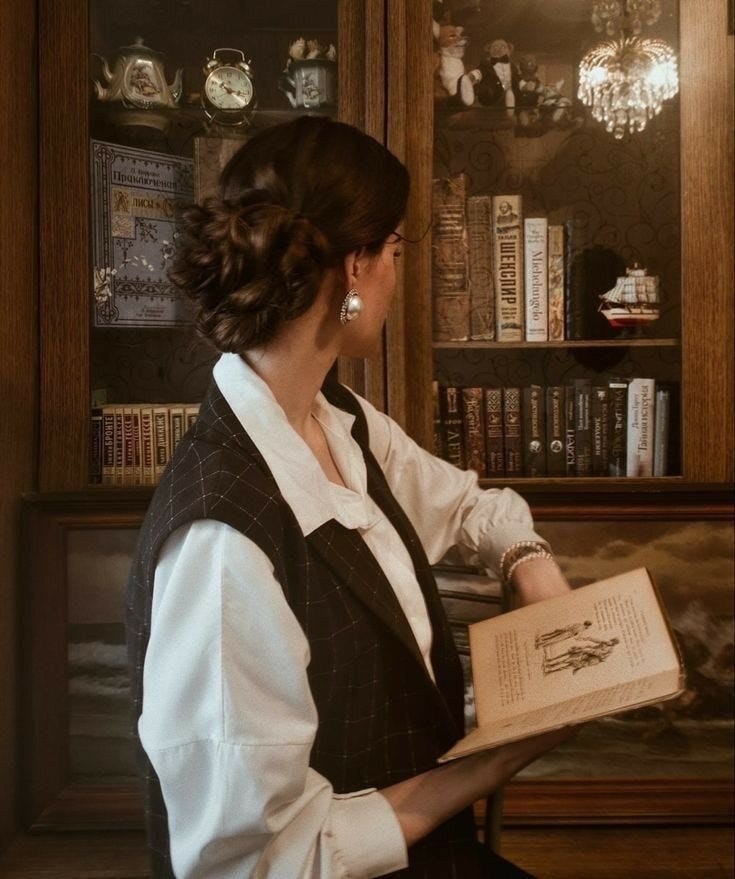
How can one become more elegant today? It is probably not the question you ask yourself on the eve of your summer engagements. Yet if you are a woman, you still take particular care to match your shoes to the ribbon of your hat, hoping to present the most elegant version of yourself. And if you are a man, you will no doubt find yourself admiring the elegance of your companion at that same event, even though she has followed rules quite different from those that guided the composition of your own attire.
What, then, is feminine elegance, and how does it differ from masculine elegance? You may also ask how a woman can apply this notion of elegance to her everyday life in practical terms. Much ink—and, at times, many tears—has already been spilled over the subject. Yet there are certain questions one never tires of asking, and so here we are once again.
The answer, I believe, begins with a single idea: harmony. In truth, everything is a matter of harmony. Elegance is not merely a question of appearance, but the outward expression of an inner order. Wherever harmony exists, beauty naturally follows.
Saint Augustine offers a helpful starting point. He observes that man is composed of three parts: the body, the mind1, and the heart. Let us resist the temptation to divide our discussion into three corresponding parts, for that would be to misunderstand his point. These three are not meant to exist independently of one another, but in harmony. We could even stop here and tell our dear readers that elegance is simply the free interplay of body, mind, and heart—but while that would not be false, it would not tell the whole story.
For harmony does not concern the individual alone. It also governs the relationship between man and woman. The notion of polarity, to which we shall return, belongs precisely here: each finds its proper fulfillment in relation to the other, and together they become one.
Let us therefore begin with the fundamental idea of balance, which lies at the heart of every harmonious result. We shall first consider the relationship between Beauty and Truth, then the harmony between man and woman, and finally the way that harmony is expressed in the body, the mind, and the heart.
Our mission here at Letters from the Old World is to share the secrets of Old World elegance, and our approach is two-fold:
1) Every Wednesday, we send a free article exploring the theology and philosophy of why beauty matters, particularly in regards to decor and dress.
2) Every Friday, we send What’s In a Fit, a members-only article exploring practical tips and guidelines for dressing well.
If this resonates with you, then subscribe below to join the aesthetic renaissance.
I. Elegance as a Form of Beauty
Let us consider, as a practical example, a woman who seeks elegance in every aspect of her life: in the appearance of her home, in the buckles of her shoes, in the grace of her smile, in the meals she serves, in her love of work well done, and in the care she devotes to the different circles of those around her.
If she truly wishes her life to be governed by harmony, she will not deliberately present a sullen countenance to others in her daily life while at the same time displaying sure taste in the way she dresses or keeps her home. No doubt a thousand counterexamples could be offered to what I have just said. But once again, our concern here is harmony in Beauty, not aesthetics in isolation.
To understand this, we must first return to what we mean by Beauty itself. For the remainder of this essay, you will permit me to give the word a capital letter and to step away from my practical example. We are, after all, dealing less with a commercial catch-all than with an idea that touches the soul.
I borrow the emphatic words of John Keats, who had no doubt read Plato, and who tells us:
Beauty is truth, truth beauty,—that is all / Ye know on earth, and all ye need to know.
Indeed, Truth is the condition of harmony between our body, our mind, and our heart. None of these three parts should deceive the other two—or itself. Whatever arises from that harmony will necessarily be beautiful. This is precisely what we commonly mean when we speak of being “aligned with oneself.”
The pursuit of such balance therefore stands opposed to every form of excess. To neglect, for example, the life of the mind in favor of the body, thus pursuing an ideal of beauty that is purely physical at the expense of the intellect, is to break that harmony. One will surely say of such a woman that she is merely beautiful. Or one’s attention will linger upon a purely visual attribute. But the word elegant will never arise.
The converse is equally true, and here I rely upon a well-known remark by Gabrielle Chanel:
If a woman is poorly dressed, one notices her dress; if she is impeccably dressed, one notices the woman.
Once again, the celebrated couturière, who abhorred anything “too much,” points us toward the necessity of harmony, here in the composition of one’s attire.
II. Elegance in the Polarity of Man and Woman
If we are to speak of elegance today, however, we must avoid the following mistake: considering woman exclusively in relation to herself.
Since we are, after all, social beings, we must broaden our discussion to encompass a woman’s relationship with the world. She was not alone in Eden. Her first encounter with otherness was man. Whether that man is her husband, her father, her brother, her son, her colleague, or the neighbor across the hall is not the essential question. Above all, he represents the Other.
I believe profoundly in the harmony of contrasts, and I want no harshness in it. Consider the painter who handles light and shadow so masterfully that the scene before us comes to life. Consider the color wheel, where colors begin to vibrate when placed side by side. So it is with man and woman.
Let us therefore free feminine elegance from the prejudices so often attached to it. An elegant woman is called neither to eclipse man nor to efface herself before him. The two should be in conversation, not at war. The same is true of their respective forms of elegance.
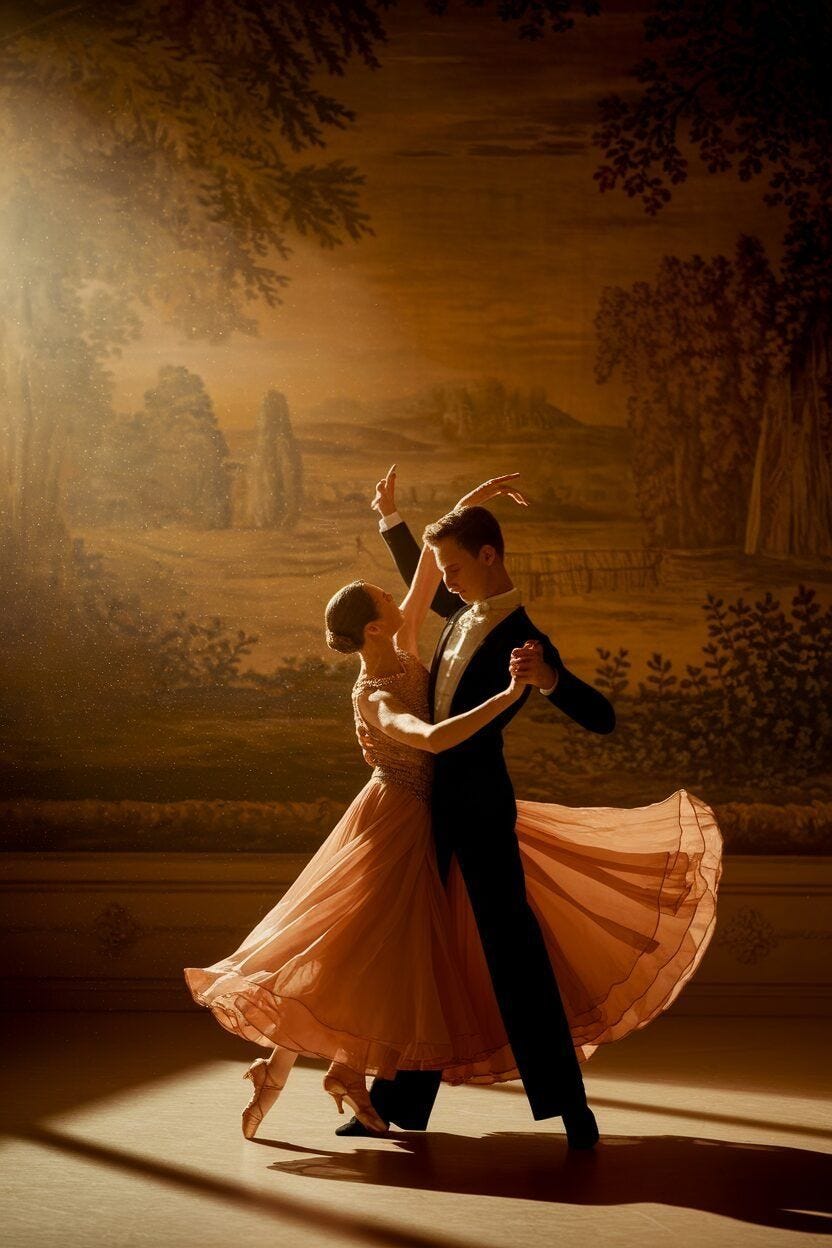
You will no doubt notice, at a Viennese ball, the abundance of shimmering colors displayed by the ladies in all their finery, while the gentlemen are dressed in black and white. Are these men any less elegant than their partners because the uniformity of their dress attracts less attention? Do the ladies, by contrast, appear frivolous because their muslin gowns are less codified, less stratified, we might say? Or does it not seem, rather, that together they create, year after year, the enchantment for which the Wiener Staatsoper is renowned?
See for yourselves: the elegant man and the elegant woman dance together, and the result belongs unmistakably to the realm of Beauty. This is what we referred to earlier as polarity.
Let us now return to our practical example…
III. Elegance of the Body
We have established that Truth is the condition of harmony, and harmony the natural source of Beauty. Let us also remember that elegance is an ideal toward which one ought to strive without obsession. We have already seen that there is nothing good in excess, as is demonstrated once again by the proper accord between our body, our mind, and our heart.
With this in mind, it becomes easy to answer the following question: how does feminine elegance extend beyond clothing and into other areas of life?
To begin with, the primary purpose of clothing is to protect both your health and your modesty. The quality of a fabric matters at least as much as its quantity or its cut. We often forget that our body speaks just as eloquently as our sense of dress. Let us therefore offer our skin natural materials such as cotton, wool, silk, linen, or leather, even if that means owning fewer garments. Better to have a smaller wardrobe composed of pieces chosen with as much care for our well-being as for our aesthetic sensibilities.
Natural materials, however, belong not only in our wardrobe, but on our plate as well. What a pleasure it is to know how to delight one’s guests! Nature, which has little regard for equality, does not bestow that talent upon everyone. Yet even if you cannot prepare a boeuf bourguignon, you can surely choose a simple ribeye with care, preferring to support your local butcher—even if less often—than your neighborhood supermarket.
As we have seen, the elegance of the body begins with the desire to preserve good health, sometimes preferring the certainty of simplicity to the uncertainty of abundance. In a word, choosing quality over quantity is not a matter of asceticism. It is the desire to give our body what is truly good for it.
IV. Elegance of the Soul
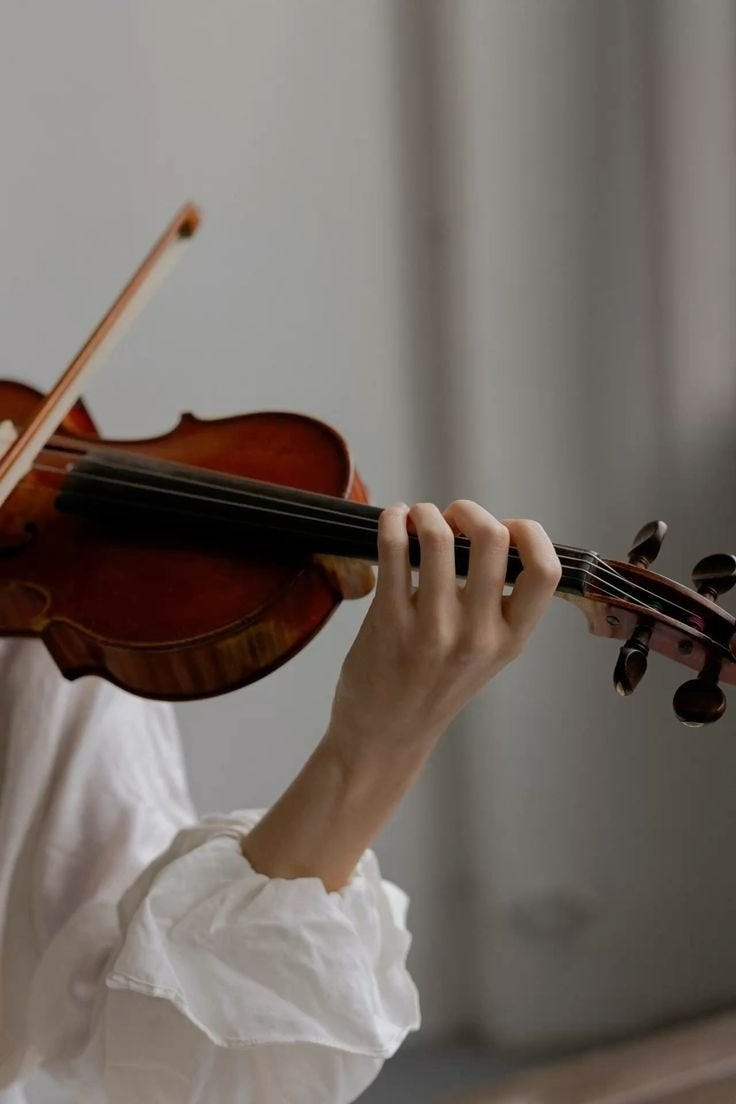
The same is true of the intellect. As with the body, elegance consists in giving it what is proper to its nature. If elegance ultimately consists in what is fitting and just, then to be elegant toward oneself is to cultivate the talent one carries within.
Sometimes, by grace, that talent finds expression in the world through what we call work. Aristotle expresses the idea well: “Where your talents and the needs of the world cross, there lies your vocation.”
Nor should we reduce the elegance of the feminine intellect to the forced accumulation of knowledge. If the great salon hostesses of earlier centuries became patrons of the arts and letters, it was because their natural inclinations led them there. That was their talent.
In France, people once admired the celebrated esprit Mortemart of the Marquise de Montespan. Yet did she therefore possess the elegance of heart more readily associated with her successor, Madame du Barry?2 In practical terms, feminine elegance in matters of the intellect is more readily found in the woman who knows how to cultivate her natural gifts and continually seeks to bring them into harmony with the world than in the one who pursues excess, as we have already seen.
The same principle governs a well-turned phrase as a well-composed outfit: it is never the most sophisticated that succeeds, but the most appropriate.
As for the elegance of the heart, we shall be careful not to presume the role of spiritual director. The heart—or, if you prefer, the soul—is the sacred messenger of this human trinity, and the bond that unites its constituent parts. To put one’s heart into everything one does is already an excellent beginning in the school of elegance. The heart, perhaps more than anything else, protects us from the excess and obsession that isolate us.
Indeed, if we were to define feminine elegance simply as a collection of rules, there would be very little left to say that had not already been said. Elegance, then, does not consist in following those rules without exception. It consists in knowing them as well as one can, interpreting them, embodying them, and allowing oneself, when appropriate, the freedom to depart from them. The heart seems to be precisely what makes such departures possible. In this, you may recognize the spirit of both the Holy Scriptures and the great Romantic movements of Europe.
Each of us carries within the heart a harmony all our own, like a different instrument within an orchestra. Let us not forget that it is the variety of those instruments, joined to their ability to play in tune, that gives a symphony both its substance and its depth.
You will perhaps allow me one final comparison, likening elegance to music or to perfume. After all, both are composed of notes, and one need only avoid the false one. Yet a piece performed by the most virtuoso of musicians, if he pours none of himself into it, will never equal the first waltz by Chopin played on the piano by your own child. Nor will the finest perfume in the world, if it awakens no memory, ever compare with the familiar scent of the person you love.
That, perhaps, is the final word on this question of true and false notes as it relates to feminine elegance.
To conclude, let us consider one last example. In these summer months, feminine elegance will lead you to choose the blouse that flatters your figure, allows your skin to breathe through the softness of its fabric, and is suited to the job interview you are attending that very morning. In a word, it will lead you to choose whatever speaks to your heart while satisfying both your body and your mind.
Translator's note: The French esprit has no exact English equivalent. Its meaning ranges from mind and intellect to spirit and wit, depending on context. Rather than imposing a single English term throughout, this translation renders esprit according to the sense intended in each passage. Here, mind best preserves the author's conceptual distinction between the body, the mind, and the heart; where esprit later refers specifically to the rational faculty, it is translated as intellect.
Esprit Mortemart was the name traditionally given to the sparkling wit associated with the House of Mortemart, to which the Marquise de Montespan belonged. The author invokes it here as a symbol of exceptional intellectual brilliance, contrasting it with the “elegance of heart” of Madame du Barry.
Glad to see this essay this morning. I’ve been hoping you would venture into more feminine concerns. I would love to see more.
Read this on the plane coming home from vacation. One of the most eloquent pieces I have ever read. So inspiring. I would definitely like to read more. Could I please see the original French to share with my friend in Montreal? Thank you