

How to Go from Cringe to Cool
A study in the psychology of success

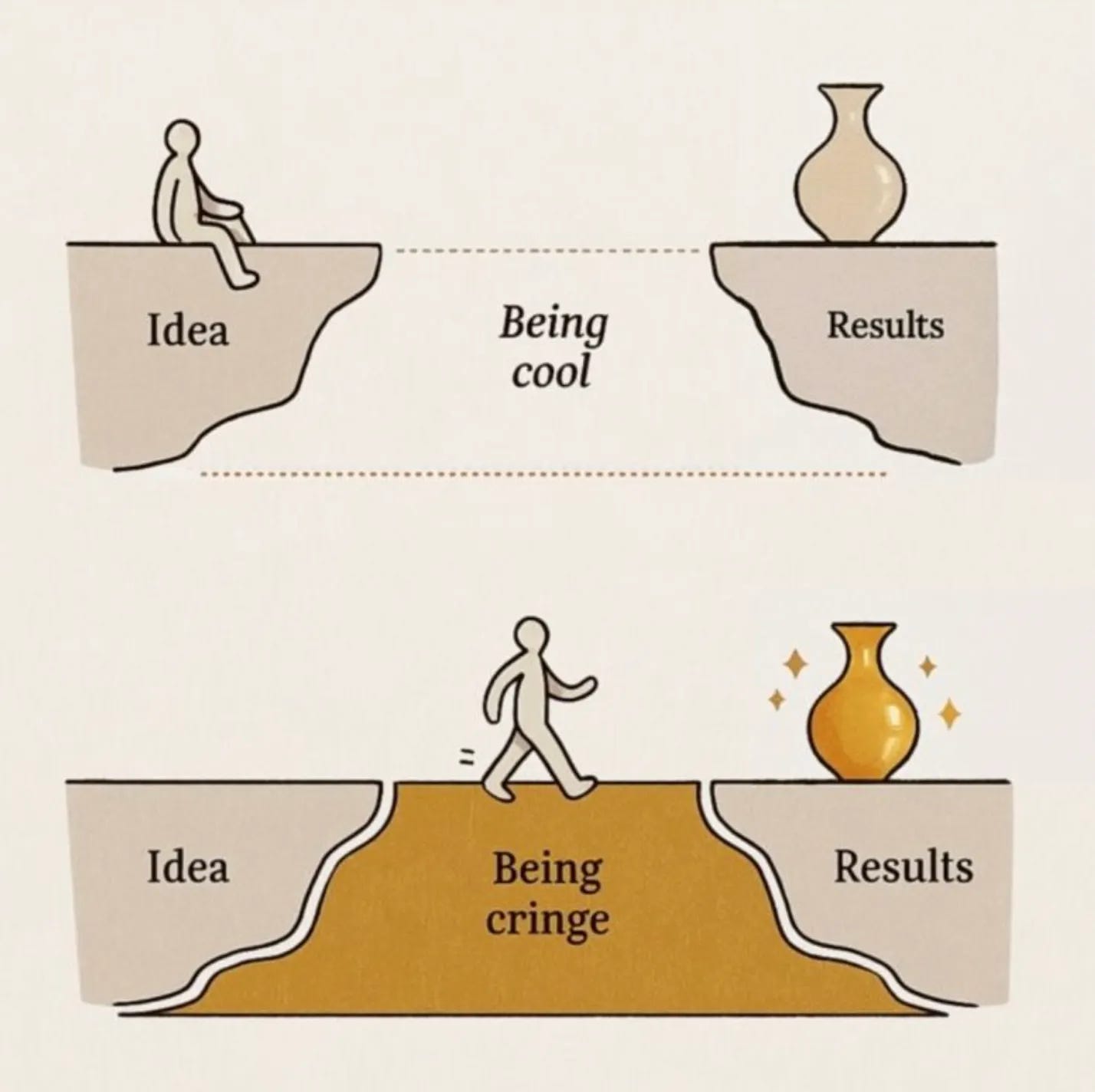
“Everything you want is on the other side of being cringe.” Perhaps it’s an idea you’ve heard before. In order to achieve your dreams, so it’s said, you must first endure the discomfort of being judged and potentially ridiculed by others. But is this true?
Unfortunately, the short answer is often yes, but not simply because Gen Z decided to label any degree of perceived effort as try-hard or “cringe”. No, this is a phenomenon deeply ingrained in the human psyche, and it’s been around for ages.
But rather than being a cause for despair, it can instead inspire you: because once you know how the game works, you can play it to your benefit. When others’ reactions are predictable, you can plot your course around them safely. It’s like sailing through a shoal-ridden bay, except now you have a map that tells you exactly where the shoals lie.
Today, then, we look at the reasons why being beats becoming in the social hierarchy, why trying is perceived as negative, and why those who push through the cringe to finally “arrive” suddenly get all their actions retroactively legitimized.
Fortunately, going from cringe to cool is much simpler than you think. But that doesn’t mean it’s easy…
Our mission here at Letters from the Old World is to share the secrets of Old World elegance, and our approach is two-fold:
1) Every Wednesday, we send a free article exploring the theology and philosophy of why beauty matters, particularly in regards to decor and dress.
2) Every Friday, we send What’s In a Fit, a members-only article exploring practical tips and guidelines for dressing well.
If this resonates with you, then subscribe below to join the aesthetic renaissance.
Being Beats Becoming

In the social hierarchy, being outranks becoming. Or, in other words, trying to be is viewed more negatively than simply being.
The reason for this is that trying is a confession of position. In striving for something more, you reveal what you don’t already have. This means that visible effort becomes something of a class signal, pinpointing where you fall in the social hierarchy.
This effect is then compounded by several factors. The first is the fact that people dislike dynamic social ladders. For as much as they might claim to be in favor of “social mobility”, a dynamic social ladder often results in their discomfort and insecurity. The reason why is that people naturally prefer stable and predictable social environments, in which their role is known and defined. If their relative status within that environment is constantly in flux because of the upward or downward movement of those around them, then their own position — and thus their security — feels threatened.
Another factor is that the success of someone else within one’s own social environment is often interpreted, at least subconsciously, as a judgment on one’s own effort. “If that person can succeed and move up in status, why can’t I? What am I doing wrong? What’s wrong with me?” These are the questions asked by an honest conscience, but all too often buried and ignored by a prideful or insecure one.
To avoid the discomfort of cognitive dissonance, the mind opts to preserve its esteemed judgment of itself and instead point the finger at others, labeling them as try-hards or social climbers. This naturally results in what’s called “tall poppy syndrome”, a phenomenon in which people who stand out from the crowd are criticized or resented by those around them.
In short, people hate becoming. But yet, it’s the only way you’ll ever achieve your goals…
The Effort of Effortlessness

I pretended to be somebody I wanted to be until finally I became that person. Or he became me. Or we met at some point.
-Cary Grant
Cary Grant is often regarded as one of the most suave men to ever grace the silver screen. From his consummate cool to his impeccable wardrobe, few could compete with him in his prime. But, of course, his apparently effortless style was anything but.
As his quote at the top of this section attests, Grant intentionally strove to cultivate his public persona and become the man he wanted to be. This necessarily required the effort of becoming. But what Grant realized is that moving from becoming to being wasn’t enough. He instead had to look as if he had always been.
This reveals another major aspect of the cringe-to-cool pipeline: that to possess social capital is one thing, but to look as though you have always possessed it is quite another.
To illustrate this, let’s take the accumulation of wealth. A man first reveals his social position by embarking on the pursuit of wealth and striving to earn more. He is most vulnerable to criticism while in the process of becoming, ie., accumulating his wealth. Once he possesses it, he is now being, and exempt from much of the criticism he endured while becoming. But because he is new to wealth, he still lacks the prestige of having always been, which constitutes the highest rank in the social hierarchy.
Now, this doesn’t mean you have to invent a fake origin story in order to make it seem like you’ve always been and be accepted by your peers. There’s another way to spin the narrative of your success once you’ve made it to the top. In fact, this is the key to making everyone forget you ever did anything “cringe” in the first place.
Retroactive Legitimization

So, what’s the secret to transforming your cringe into cool? The answer is simple: success.
While trying is unforgivable as it happens, your arrival at the top suddenly changes everything. The class signal flips, and the narrative rewrites itself. Now, instead of calling you a try-hard, people say “he was always going to make it”. Once your success appears like it was inevitable, all of your effort and trying is forgiven.
Let’s return to the example of new money: even if you haven’t always been wealthy, your new position of being wealthy is justified because the always been applies to something else: for example, your character and work ethic. You have always been a winner, it just took time for that to become evident to all. Where you were once criticized for trying, you are now lauded for your perseverance and vision.
But why? Why does success legitimize everything? The reason is that once your success appears as though it were inevitable, that sense of inevitability makes it seem like the trying didn’t have to happen. It was just someone becoming who they were always meant to be, not someone striving to become someone they are not. Order is restored to the social hierarchy, and the world is safe and predictable again.
Of course, this is all nonsense. No success is inevitable, nor does it come about without great exertion of effort. But people love to live under their comfortable illusions.
You don’t have to agree with the rules of the game to play by it. Simply by knowing how people will react when you begin to strive for something greater, you can feel more confident in shrugging off their early criticisms. Forgive them, for they know not what they do. Remember, all will be forgiven once you achieve success.
My hope in writing this is that by helping peel back the curtain on how this aspect of human psychology works, you feel more empowered to pursue your higher calling. Start dressing better, working out, or studying French in your free time. Don’t worry about what others think, or about feeling like an imposter. By simply persevering in your course, you’ll eventually become the man or woman you seek to become. And when you do, everyone will celebrate your success and claim it was inevitable.
“I pretended to be somebody I wanted to be until finally I became that person. Or he became me. Or we met at some point.” May it be the same with you.
I've found that, most often, we doubt our own ambitions because we subconsciously know our opinion to be subjective. Whereas a third party's seems objective, and we sometimes need its affirmation to convince us of our idea's truthfulness.
Thank you, Evan, for this optimistic article.
There is a lot of truth here; I've often been perplexed by this part of human psychology and am also guilty of shying away from pursuing things because of how it may be perceived.
The quote reminds me of a friend of mine who worked as a salesman in London for a printer company. It was a standard office job in London, and he spent most of the day making cold calls (picture The Office). Without fail, he always went to work in a three piece suit and when I asked him why he did that, he said 'dress for the job you want, not the job you have.' I'm not sure what job he wanted, but I admired the attitude.