



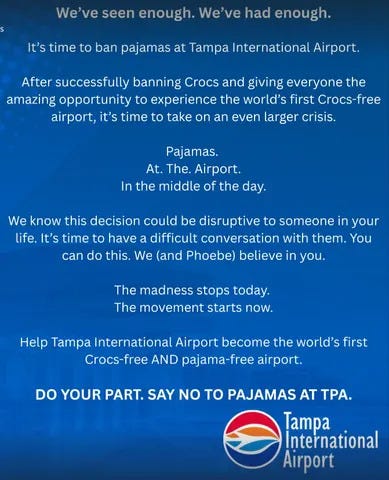
Back in February the Tampa international Airport wrote what many of us are thinking when we go to the airport: enough with the pajamas. “The madness stops today. The movement starts now. Help Tampa International Airport become the world’s first Crocs-free AND pajama-free airport. DO YOUR PART. SAY NO TO PAJAMAS AT TPA.”
While the post was satirical, its virality is proof the joke struck a nerve. Many complained about what they saw as elitist shaming of a choice to prioritize comfort in an already uncomfortable environment. Still others were supportive of the idea, saying it was a matter of respect in a public space. With more airlines instituting rules on travel wear, it’s clear this conflict between comfort and respect is coming to a head. So who’s right? And how should you dress when traveling?
Our mission here at Letters from the Old World is to share the secrets of Old World elegance, and our approach is two-fold:
1) Every Wednesday, we send a free article exploring the theology and philosophy of why beauty matters, particularly in regards to decor and dress.
2) Every Friday, we send What’s In a Fit, a members-only article exploring practical tips and guidelines for dressing well.
If this resonates with you, then subscribe below to join the aesthetic renaissance.
The Golden Age of Travel Starts With You
Tampa International isn’t the only air travel entity that’s made changes of late. Last year, Spirit airlines updated its contract of carriage to forbid guests from boarding planes if they had clothes or body art that was lewd, obscene or offensive. It also forbade people from going barefoot or being “inadequately clothed,” meaning see through clothes that exposed private parts. Other airlines, like Southwest, United and American Airlines all now have similar baseline restrictions around offensive clothing and going shoeless.
Also in 2025, the US transportation department launched a civility campaign, “The Golden Age of Travel Starts with You” to address an increase in passenger disruptions and make flying more courteous. One of the 5 key questions the campaigns wants flyers to ask themselves is whether they are dressing with respect? In the department’s announcement of the campaign, they wrote: “We can all do our part to bring back civility, manners, and common sense. When we can unite around shared values, we can feel more connected as a country.”
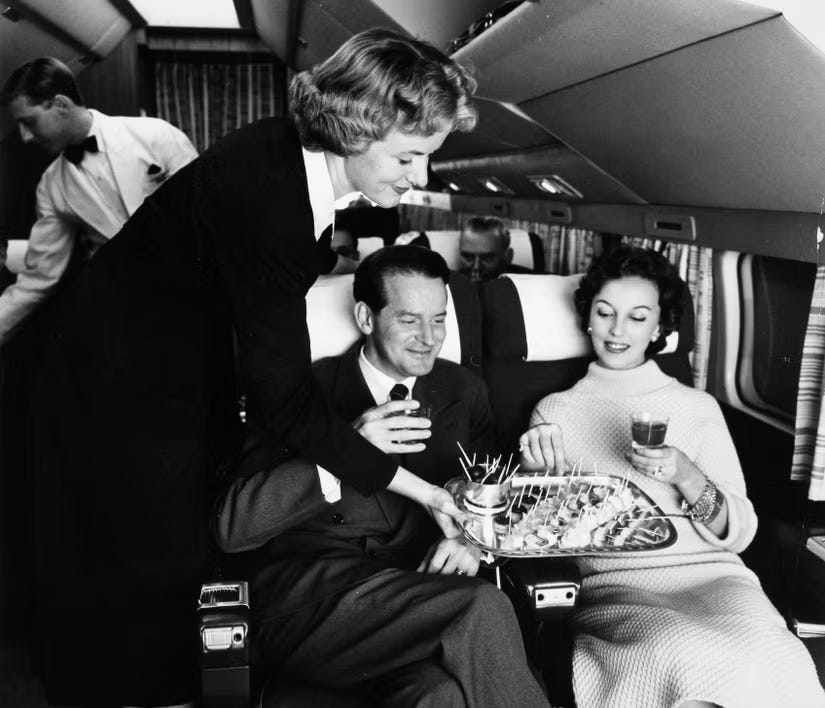
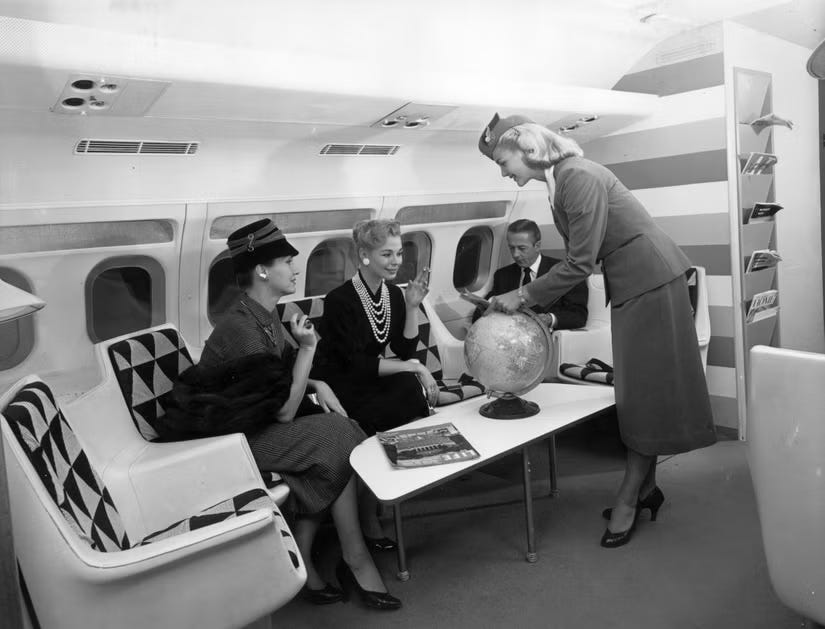
The name of the campaign refers to the halcyon days of early commercial flight in the 1950s and 60s, where comfort was the priority, the food was gourmet, and airplanes were designed with entertainment in mind instead of security or revenue maximization. At the time, the airport and airplane were destinations, luxury experiences (with a corresponding price, mind you) for which people dressed the part.
You could argue that desire and imposition of basic dress codes are either a sign that people long for some basic decency or that the social contract is so broken that we need to mandate the basics. Either way, we’re now at a point where we’re having to remind people to wear shoes.
So what happened?
Airports Became Liminal Spaces
Believe me when I tell you there was once a magical time when taking a trip on an airplane was glamorous—for everyone. There was indeed an era when ordinary humans arrived at the airport in suits and dresses; when passengers didn’t have to yank off their shoes at security; when you didn’t sit wedged into seat 35F paranoid about the sneezes of the barefoot schnook in 36E.
- Jodi Peckman, Come Fly with Me
The short answer is that these once refined, elite spaces were opened up to a broader and less wealthy public, transforming them from luxury accommodations with dance floors and piano bars to the cattle cars we know today. This change was thanks to deregulation of the airline industry in the 1970s, increasing the need to be competitive, in combination with improvements in aviation technology, which allowed for more carrying capacity. Both these factors helped make flights far more affordable to the average person, but at the cost of the frills of the fifties and sixties. As the public that boarded planes changed to reflect these new priorities, so too did the airports harboring them. Thus airports and airplanes, once experiences in their own right, became merely liminal spaces – areas in-between other, more important spaces.
In fact, airports are one the most liminal spaces we have, existing as the intersection between nations, cultures, ground, and sky. Travelers pass through on their way to vacations, work meetings, family gatherings and sporting events. This means that without the price barrier selecting for “high net worth” that used distinguish travelers from regular people, it has become more difficult to have expectations for such spaces, as everyone from everywhere is at the airport.



.jpg)
A 2018 study titled Airports as Liminal Space published in the Annals of Tourism Research looked at how passengers use international airports as both destination and social space. It found that what an airport represents to passengers depends on whether they were seasoned flyers, whether the airport was local to them or foreign, and other factors. It also found they served as a place where social distinctions blurred due to the odd, in-between nature of travel equalizing everyone temporarily: “the liminal nature of airports allows for unique interactions and experiences that break the boundaries between home and away, and between work and leisure.”
While the study found that people were more likely to help or chat with strangers, the liminal nature of airports also allowed travelers to forgo feelings of obligations to others through the relative anonymity typical of such spaces. It also noted that liminal spaces allowed people to disconnect from their digital lives, using the airport as “personal time.” It makes sense then that, in a relative no man’s land with few kinship bonds between travelers, people would feel comfortable prioritizing their comfort over communal respect.
All these factors go some way to explain the relative laxity of dress in airports, but should that translate to a bare minimum expectation?
What can You Do About It?
It made sense to dress to the nines when you envisioned yourself sipping an apéritif and networking with fellow erudite travelers. Today, as many commentators pointed out after the announcement of the department of transportations’ campaign, economy passengers are signing up for what is essentially a barebones sky bus, not a luxe experience, and thus comfort beats style for them.
But contrast this with Qatar airways having a smart casual dress code for its business class passengers. Interestingly, the airline says that maintaining this standard ensures both comfort for their clients as well as respect for other passengers, highlighting two things. One, the more expensive seats on planes seek to operate as the natural heirs to the golden age of flying, not only offering more comfort and amenities, but also carrying higher expectations. Two, Comfort and respect can, and should, go hand in hand.
As we’ve written about before, style should be comfortable. If you don’t feel good wearing your clothes, it will impact your overall presentation, undercutting the power of proper dress, and make you less likely to wear your clothes. Because so much of our clothing is now cheap, and many people don’t understand how to dress for their body types, nice clothes have acquired a reputation for discomfort. It’s no wonder so many opt for crocs, sweatpants and pyjamas if that’s the only comfortable clothes they known. But once you know how to dress well, you’ll realize you can do both, even on a transcontinental flight, and not sacrifice anything:
The reason we dress so poorly today is not because we desire comfort, but because we don’t know what comfort truly is. In other words, it’s not about fabric, but philosophy. Most people’s idea of comfort only takes into account one aspect of what the concept really means.
– Evan Amato, The Myth of Comfort
This is why small adjustments, like ensuring your clothes aren’t tight, wearing your pants on your natural waist and not the hips, prioritizing breathable materials, etc. mean that even your posh outfits can provide you with comfort. The simple changes we’ve suggested in the piece above and our other What’s In a Fit articles can go a long way to making the tension between comfort and style a moot point.

As for “sticking out” in the crowd of travelers, remember that the airport, as a liminal space, provides a unique level of anonymity and freedom other spaces don’t. That means you can experiment more freely there than almost anywhere else. Who knows where you came from, or where you’re going? No matter what outfit you choose to wear, there’s a destination that will surely be appropriate for it. The same liminality that others use to dress down, you can use to dress up!
Finally, a reminder that, in a time where many have abandoned good taste, there are still excellent reasons to dress properly. In our piece on dressing for civilizational decline, we point out that in situations where the customs are lacking, you can draw on the true source of dignity to dictate your wardrobe:
When you derive your value from God and not the world, you can dress to reflect this truth. This is because custom is secondary to natural law. Where custom is evident, it can help inform our choices, like not wearing a three-piece suit to a waterpark. However, in situations where custom is unclear and there is room for dignified dress, natural law, because of its transcendent origin, is the final arbiter.
The biggest problem: airlines treating passengers like luggage. Ever shrinking economy legroom, flying narrow body planes (I remember flying wide body jets between Houston and San Francisco), bad food (if at all), rude flight attendants (mostly in the US and on European low cost carriers), overcrowded airports. How can you dress nicely for this? Sure you don’t have to be a complete slob but this kind of treatment and environment do not encourage elegance.
These days, airport fashion is disgraceful… I don’t even know why it’s become a thing for people to wear pyjamas at the airport. Like, why? I don’t get it. Doesn’t make any sense. The airport is another outside place, isn’t it?