

How to Dress For Civilizational Decline
What to wear in the absence of standards


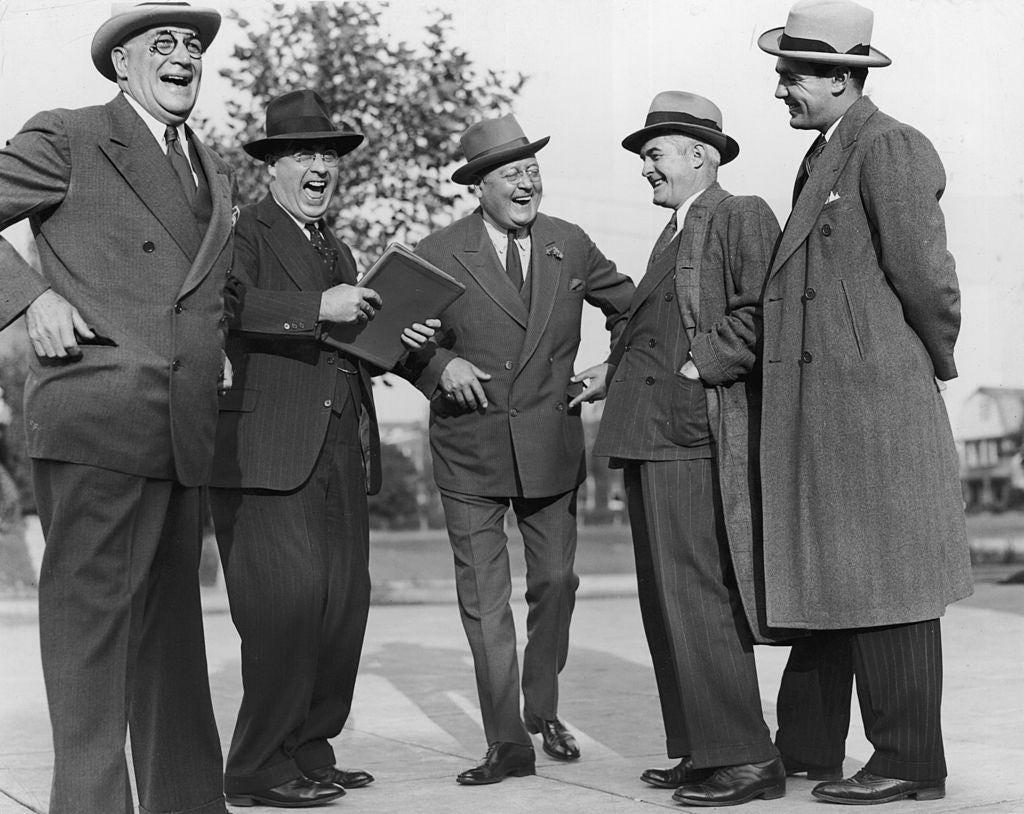
In photos of societies from the early 20th century, you’ll notice that people often wore the same things as each other. The norms were fairly set. Part of this was lack of access to inexpensive mass-produced clothing, sure, but part of it was also a cultural consensus. You knew what to wear to work, to church, at home, etc., because everyone did.
Nowadays, the very idea of norms is seen as oppressive by some. That breakdown is evident in the vanishing standards for public dress. You know that dressing well is a matter of norms, but how can you dress well in a place that refuses the imposition of standards? And would it be humble or lazy to “conform” to this lack of expectations?
Today, we look at why standards of dress have declined, what responsibilities you have in a world that rejects norms, and why the duty to dress well doesn’t disappear when cultural standards do.
Let’s begin…
Our mission here at Letters from the Old World is to share the secrets of Old World elegance, and our approach is two-fold:
1) Every Wednesday, we send a free article exploring the theology and philosophy of why beauty matters, particularly in regards to decor and dress.
2) Every Friday, we send What’s In a Fit, a members-only article exploring practical tips and guidelines for dressing well.
If this resonates with you, then subscribe below to join the aesthetic renaissance.
The Collapse of Cultural Norms

We can assert with some confidence that our own period is one of decline; that the standards of culture are lower than they were fifty years ago; and that the evidences of this decline are visible in every department of human activity.
–T.S. Eliot, Notes Towards the Definition of Culture
In 1897, C.E. Humphry dedicated a whole chapter in Manners for Men on the importance of dress to man’s social life. “If a man does not dress well in society he cannot be a success,” wrote Humphry. “If he commits flagrant errors in costume he will not be invited out very much, of that he may be certain.”
Just over a century later, even the most successful among us don’t hold to this rule. This is particularly jarring because of the social responsibility elites were once expected to hold. As T.S. Eliot writes in Notes Towards the Definition of Culture:
It is the function of the [elite] class as a whole to preserve and communicate standards of manners – which are a vital element in group culture.
While some excuse the abandonment of standards as a mere relaxation or allowing for more comfort, the danger is this attitude seeps into every area of life. As an example, in an earlier piece, we quoted fashion consultant Tim Gunn, who relates just how “relaxed” these norms have become for some:
I have heard from brides that they feel disrespected by guests who show up in tracksuits, or by the bereaved when their friends show up tieless and jacketless at the funeral home.
The problem isn’t just aesthetics but philosophy. Tracksuits at a wedding are what happens when we can’t agree that there are objective values and real standards that we should all insist upon. It is representative of the increasing subjectivity of meaning, a rejection of symbolic distinctions between things. You can’t know whether something is fitting to wear if there is no shared objective standard for making that determination.
It’s a culture that rejects the idea of the intrinsic fittingness of things, and it’s the exact thing C.S. Lewis tried to warn you about.
The Loss of Natural Law

In C.S. Lewis’ Abolition of Man, he uses the term Tao to refer to the doctrine of objective value: what others would call natural law, God’s law, or traditional values. For Lewis, the Tao provides a common human law, inherent and self-evident, which applies to all: “the belief that certain attitudes are really true, and others really false.”
The loss of Tao is what makes navigating the modern (lack of) expectations for dress so disorienting, because within a subjective system one point of reference is as valid as the next. So where your ancestors would have relied on their peers, you now get to look at a cacophony of clashing styles. Where once the Tao informed the world in the language of the true and false, real or unreal, beauty or ugliness, society now questions the very concepts themselves.
This is why Lewis believed that a “dogmatic belief in objective value” was necessary. Without it, culture is unable to set high standards and you have no way to orient yourself.
But just because society won’t do what’s necessary doesn’t mean that you can’t.
Virtue to the Rescue

While the world slides into confusion by debating the existence of objective value, Christians know it exists. As such, there is a good argument that, to borrow from Eliot, you belong to the class of people who must maintain the manners of society.
But doing so in the current climate is challenging. We are told by the likes of St. Augustine and St. Francis de Sales that in matters of clothing, Christians should consider their environment and their place within it when deciding what to wear. This presupposes that the environment — meaning the place, time, people, or some combination of the three — would make demands of you. But as such demands become rarer, what was once seen as normal can come to be seen as outlandish or performative. Isn’t the humble thing to do to not rock the boat?
Aquinas would disagree. In the Summa Theologiae, he offers of the virtue of magnanimity as the better response. If you are not familiar, magnanimity is the characteristic of someone who rightly esteems themselves as capable of, and striving toward, great and worthy things.
The magnanimous person, Aquinas writes, “strives to do what is deserving of honor, yet not so as to think much of the honor accorded by man.”
When you derive your value from God and not the world, you can dress to reflect this truth. This is because custom is secondary to natural law. Where custom is evident, it can help inform our choices, like not wearing a three-piece suit to a waterpark. However, in situations where custom is unclear and there is room for dignified dress, natural law, because of its transcendent origin, is the final arbiter.
A Practical Ethic

To dress with care when those around you don’t isn’t necessarily vanity. Vanity comes from the desire to aggrandize yourself, especially in relation to your peers. Likewise, if you dress down for fear of standing out, it is not humility. When you recognize where your real worth comes from, you refuse to diminish it for the sake of conformity. In those instances, in the words of Aquinas, you become magnanimous, someone who “deems himself worthy in accordance with his worth.”
Thus, grounding yourself in God and tracing your intentions back to him are key. To forego presenting yourself with care because your environment doesn’t care is no solution.
Instead, dress honestly in proportion to your worth. What is truly fitting remains so, even if the whole world forgets it.
Because after all, the ultimate standard is a transcendent one.
I was taught by my “greatest generation” elders to always dress thoughtfully in clean, mended, well-fitting clothing. That doing so indicated a respect for myself - and respect for the other people and occasion I was going to be around.
It wasn’t about pretense, etiquette or style, as much as reflecting a basic regard for the world I was showing up for and those in it.
Excellent. I have owned and designed for my historical pattern company since 1997, and I tend to dress in a way many perceive as “vintage,” although I would classify it as choosing timeless designs that are dignified and flattering. What drives me batty are the cosplayers who want to wear (say) 1940s or 1950s outfits but loudly declaim they are for “vintage styles, not vintage values.” Our values create our styles. You can’t have it any other way.