

Why Some Buildings Hate You
How to reclaim humane architecture


It’s easy to assume that how you feel in a given space is mostly about you. Besides, if a certain area makes you feel uncomfortable, uneasy or unwelcome, you can (usually) just leave, right? But there’s actually evidence that you’re being alienated from your environment on purpose and the consequences are more dire than you think.
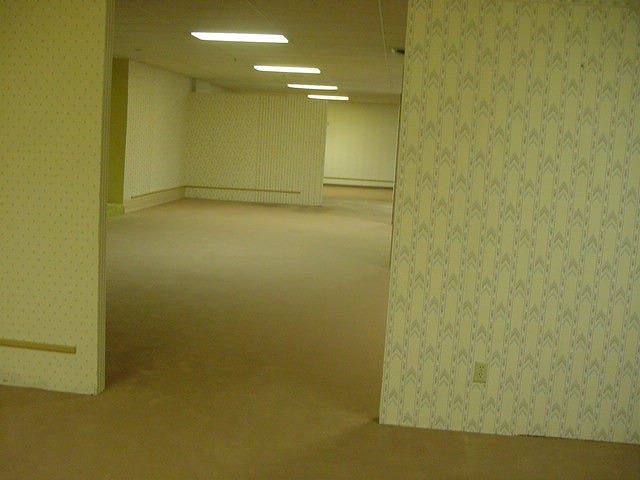
As made evident by the latest big indie film Backrooms and the online story which spawned it, humans know there’s something eerie about spaces made to be used and not loved that elicits dread. It’s an acknowledgement that just because a space is man-made, doesn’t mean it’s made for man. Today’s spaces and structures are increasingly incorporating anti-human designs and systems, sapping your ability to make your own space and attacking the spiritual vitality of your surroundings.
Fortunately, there are thinkers and philosophers who are sounding the alarm, and their advice can help you meaningfully navigate the minefield of modern architecture without losing your humanity.
Our mission here at Letters from the Old World is to share the secrets of Old World elegance, and our approach is two-fold:
1) Every Wednesday, we send a free article exploring the theology and philosophy of why beauty matters, particularly in regards to decor and dress.
2) Every Friday, we send What’s In a Fit, a members-only article exploring practical tips and guidelines for dressing well.
If this resonates with you, then subscribe below to join the aesthetic renaissance.
Hostility in the Home (and Everywhere Else)

For all the ugliest and most deadening places in the world are made from patterns as well.
–Christopher Alexander, The Timeless Way
Architecture is an art form you witness whether you want to or not. Every space, every design choice and every building communicates something. According to philosopher Roger Scruton, this carries with it moral weight and obligation. In his work The Aesthetics of Architecture, he writes that buildings either attract or repel us, even as they serve their useful function. Part of this distinction is made evident in the distinction between a house and a home, for example. But where a home might embody “welcoming,” and a house may be used as a neutral descriptor, the lack of terminology for a “hostile” house exemplifies how this space in the attraction/repulsion spectrum is underexamined. And yet, once you’re made aware of it, you’ll notice it everywhere.
The concept of disciplinary or hostile architecture should raise eyebrows for anyone who cares about community spaces. These are structures put in place in order to discourage people from using them, like the UK’s Camden bench, a design that sacrifices style and comfort (which were once the priorities in a bench) for something that resists stickering, graffiti, or even laying down.
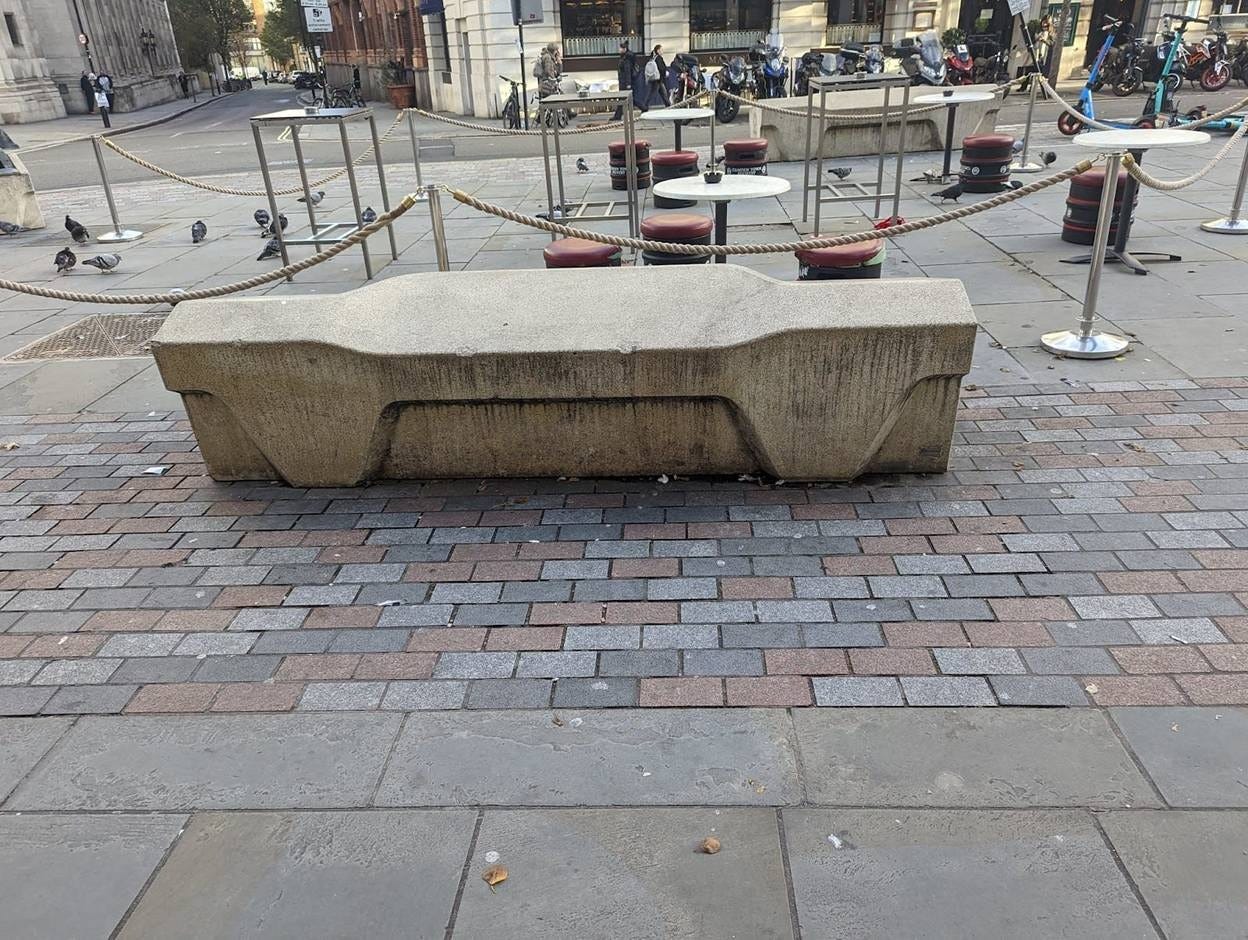
Another example are the metal ticks, sometimes called “pig’s ears”, that added to smooth surfaces and low walls to prevent skateboarding or rollerblading, or layouts of “decorative spikes” placed close together to prevent people from walking or sitting there. Most of these elements are meant to “deal” with homelessness or delinquent youth, but the end result is filling community space with designs that are explicitly anti-human.
Another aspect of the anti-human in design is, as we’ve covered before, the allergy to ornamentation and decorative touches seen in barren buildings, like those promoted by corporate glass tower standards or brutalism. These emphasize the functional over the spiritual, resulting in plain surfaces that feel alien to humans. Such places are built to be enormous and imposing, the opposite of “human scale”, in order to prioritize other things, like cars in the case of many mid-sized American cities, or efficiency in the case of quick-build skyscrapers built during boom years. Modernists also favored large, imposing structures that allowed them to make use of innovations in engineering and technology to create new forms, rejecting classic, historic styles for novelty. This cohort became so distant from the man on the street that they left their fellow humans feeling alienated and ant-like next to their structures.
As on the nose as it may feel, this picture of ivory-towered experts ignoring the wants and needs of those on the ground is more appropriate than you may think…
A Loss of Language and Intuition
In those buildings that serve purely practical purposes, in which the practical activities have been robbed of their poetry—buildings that are mechanized and depersonalized—technical perfection and pure functionality have nothing to do with artistic beauty.
–Dietrich Von Hildebrand, Aesthetics Vol. II
In designer/architect Christopher Alexander’s book The Timeless Way of Building, he writes of the “quality without a name”, which he says is the “root criterion of life and spirit in a man, a town, a building, or a wilderness.” He attempts to define it by listing concepts that approach but don’t fully encapsulate what this unnamed quality means, like “alive,” “comfortable,” “free,” “egoless” and “eternal.”
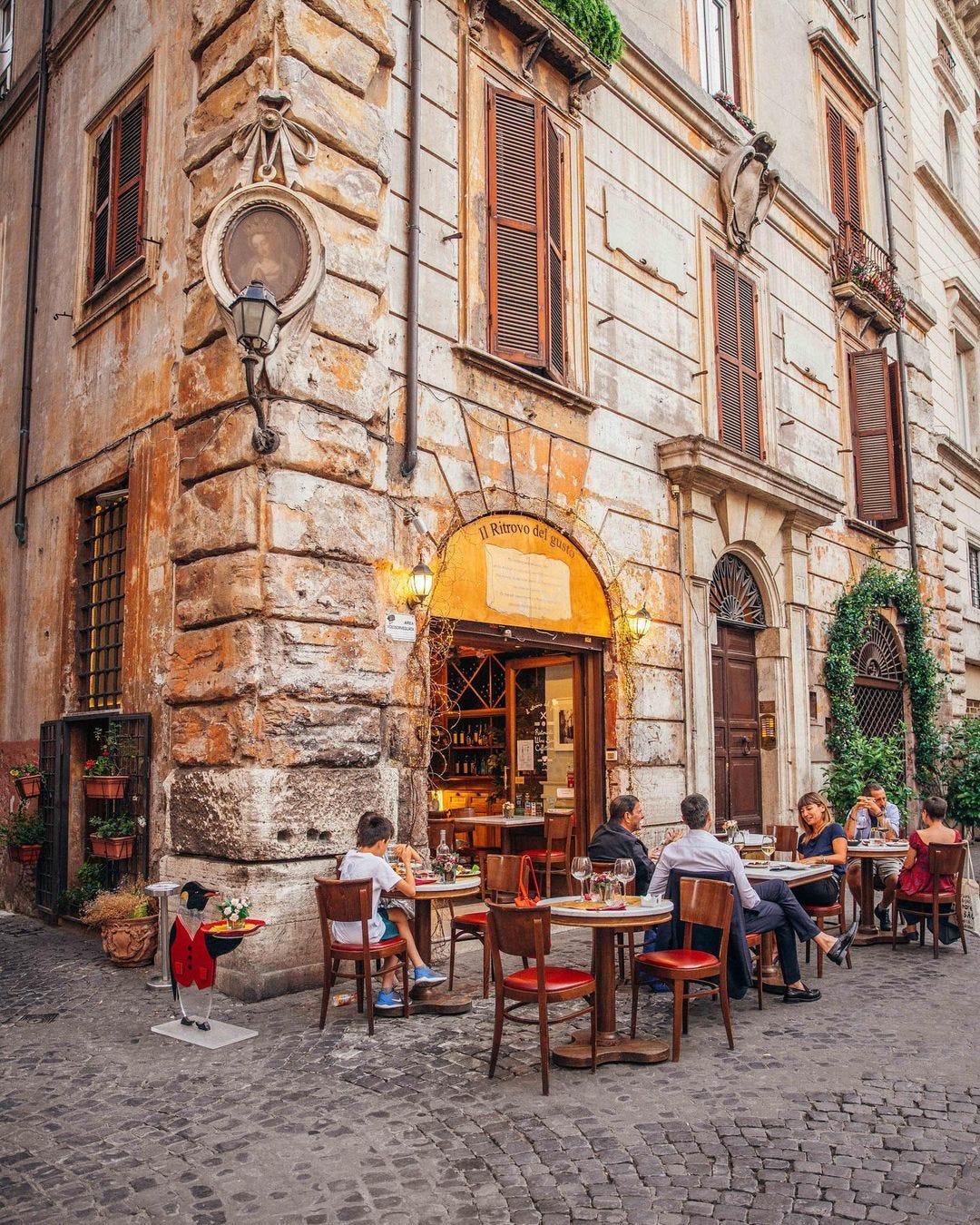
To say a place is “alive” for example is difficult to describe, but easy to recognize. It’s the difference between a thriving European side street’s cozy cafes and intimate evening lighting and the sterility of a grey downtown office block’s monotony and unbroken angularity. In short, you know it when you see it.
For Alexander, much of this quality comes from what he calls a pattern language, which for brevity’s sake can be described as a series of patterns, which can include familiar motifs, languages, cultural and practical innovations, recurring in given contexts.
Alexander says that in the early phases of industrial society, pattern languages die as they stop being common, communal knowledge and instead become specialized and the sole domain of “expertise.” Now engineers, planners, architects and consultants are the only ones able to “speak” these specialized languages. According to Alexander, this problem is exacerbated because experts not only guard their language jealously to make themselves indispensable, but they also gatekeep knowledge from rivals and competitors, further removing the pattern language from organic, communal evolution.
Now, most people don’t think themselves capable of designing their environment, as this once practical skill is seen as specialized. Communicating along these lines is no longer an everyday experience as people lose touch with their intuitions. When architects decide that glass picture windows are good, it’s taken as gospel by the average person, even if something within them says they’d prefer being in a room with smaller windows.
This new expert class has developed its own pattern language, one of plate glass and steel, meant to be divorced from particular times and places (while ironically being very much a product of contemporary mores). As Alexander writes:
So long as I build for myself, the patterns I use will be simple, and human, and full of feeling, because I understand my situation, but as soon as few people begin to build for ‘the many,’ their patterns about what is needed become abstract; no matter how well meaning they are, their ideas gradually get out of touch with reality, because they are not faced daily with the living examples of what the patterns say.
Sad as this loss of pattern language and intuition may be, there’s something more important at risk when we make buildings anti-human, something with much larger implications…
Divine Designs
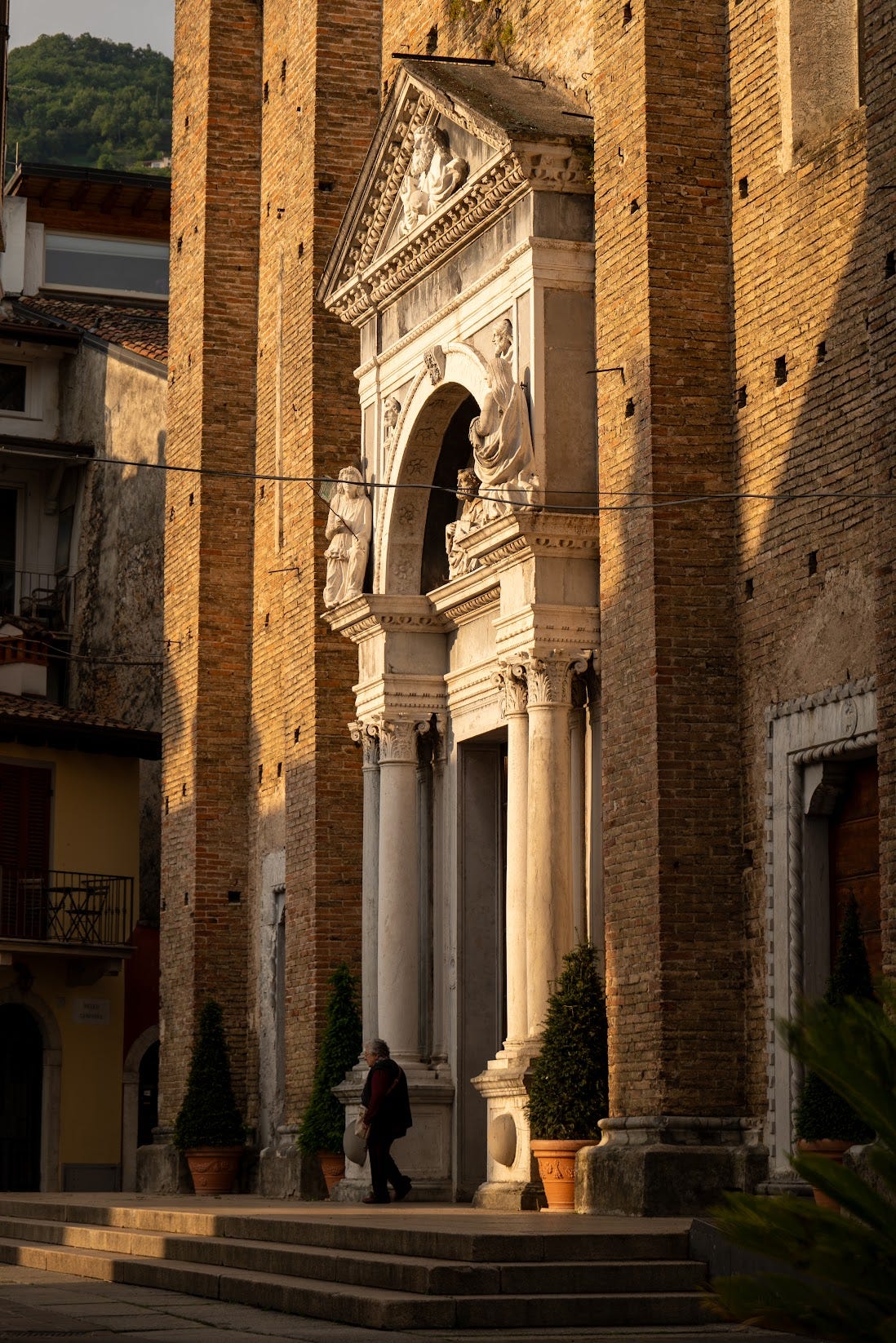
That beauty leads towards the divine is a given within Christian thought. Thus all art, including architecture, has the potential to direct and reflect the divine as a function of its beauty. While this is most evident in explicitly religious structures like churches, every instance of artistic expression carries this potential. The Catechism of the Catholic Church puts this elegantly in section 2501:
Arising from talent given by the Creator and from man’s own effort, art is a form of practical wisdom, uniting knowledge and skill, to give form to the truth of reality in a language accessible to sight or hearing. To the extent that it is inspired by truth and love of beings, art bears a certain likeness to God’s activity in what he has created.
This is why giving over the most prominent works of art in your community to experts trapped in trends and pattern languages is a spiritual risk. Those that don’t account for their works’ potential to touch souls create spaces that may be functional, useful or even interesting, but they overlook something vital.
For Dietrich Von Hildebrand, while a home must necessarily be practical, its real goal should be to host a human being’s real, intellectual and affective life. As he writes in the second volume of his Aesthetics, this is only possible through artistic beauty that both elevates and nourishes your spirit. When this quality is absent, he writes, the consequences are not merely a rejection, but a negation of the soul:
[A] modern building that fulfills all the practical requirements and is perfect with respect to civilization is usually a wretched construction from the artistic point of view. It almost always radiates an anonymous barrenness, a depressing prosaic character.
[…] its absolute barrenness, anonymity, and soul-lessness, and the lack of any charm whatever, form an antithesis to artistic beauty that is just as great as the trivial.
Retaking the Language of Design

If all this seems dire, then take solace knowing that the path back to a more human environment is not as onerous as it might seem. The first step is to rescue the pattern language that’s been slowly drained from you. You can do this by being curious and taking the time to notice your surroundings. You literally have a machine that can tell you the name and uses of everything around you in your pocket 90% of the time. For once, use it to make you more aware of your surroundings, not less. Once you grow familiar with the patterns around you, you can start to question whether they do, or don’t, have that quality without a name that Alexander wants you to notice.
If they do possess it, challenge yourself to figure out why that is. Is it the scale, the lighting, the colors, the materials? Make your intuition for design a conscious process until it becomes second nature. When that “aliveness” is lacking, when the spaces around you are actively unwelcoming, figure out why, and make those responsible for their design and approval justify the decision. This could mean writing your local representatives, or better yet, showing up to council meetings. You may be surprised how effective a few voices can be at the local level; the “experts” aren’t used to being challenged.
Should you find yourself in a position to make real changes, large or small, Von Hildebrand suggests a middle path between the functional and aesthetic when it comes to common work spaces. His advice is applicable beyond the workplace, though, striking at the heart of the issue and offering perhaps the most direct, and beautiful, answer to the anti-human in architecture:
A modest, simple, but noble architecture is appropriate here, an architecture that in its expression and its atmosphere does justice to the fact that human beings work in these buildings: human beings who are destined objectively for a rich interpersonal and nonmechanized world full of the poetry of human life.
This reminds me of a scene in C.S. Lewis's Space Trilogy in which the protagonist finds himself in a room that is very threatening, though not in obvious ways. The horror of it is in things being just off of straight or symmetrical, or of pieces of art containing very obscure ugliness.
This can also be observed in the fact that most consumer things are either made or designed by people who will never use them, resulting in inefficient, ugly, cheap and poorly-functioning items. Everyday items also used to be beautiful. Now they are purely functional, if that.
This has been a great concern of King Charles III. He has written a wonderful book about this very issue and has even designed a community to put his ideas and theories into practice.